<?xml version="1.0" encoding="utf-8"?>
<feed xmlns="http://www.w3.org/2005/Atom">
    <id>https://docs.mative.ai/blog/</id>
    <title>Mative Docs Blog</title>
    <updated>2026-09-25T00:00:00.000Z</updated>
    <generator>https://github.com/jpmonette/feed</generator>
    <link rel="alternate" href="https://docs.mative.ai/blog/"/>
    <subtitle>Mative Docs Blog</subtitle>
    <icon>https://docs.mative.ai/img/favicon.ico</icon>
    <entry>
        <title type="html"><![CDATA[Investimenti Sostenibili 4.0 grant: how IoT turns 75% funding into measurable savings]]></title>
        <id>https://docs.mative.ai/blog/2026/09/25/2026/investimenti-sostenibili-4-0-grant/</id>
        <link href="https://docs.mative.ai/blog/2026/09/25/2026/investimenti-sostenibili-4-0-grant/"/>
        <updated>2026-09-25T00:00:00.000Z</updated>
        <summary type="html"><![CDATA[The "Investimenti Sostenibili 4.0" grant covers up to 75% of eligible costs for southern Italian SMEs. Learn how IoT data collection, real-time monitoring, and energy analytics meet the 5% annual savings requirement and strengthen your application.]]></summary>
        <content type="html"><![CDATA[<div style="text-align:center"><img src="https://docs.mative.ai/img/blog/2026-09-25-investimenti-sostenibili-4-0-grant-en.jpg" alt="Investimenti Sostenibili 4.0 grant: how IoT turns 75% funding into measurable savings" style="width:100%;height:auto"></div>
<h2 class="anchor anchorTargetStickyNavbar_Vzrq" id="introduction">Introduction<a href="https://docs.mative.ai/blog/2026/09/25/2026/investimenti-sostenibili-4-0-grant/#introduction" class="hash-link" aria-label="Direct link to Introduction" title="Direct link to Introduction" translate="no">​</a></h2>
<p>The <strong>"Investimenti Sostenibili 4.0"</strong> grant opens on 6 October 2026, offering southern Italian SMEs up to <strong>75% funding</strong>—35% as a non-repayable grant and 40% as a zero-interest loan—for projects that combine <strong>Industry 4.0 technologies</strong> with measurable energy savings. The call prioritises applications that demonstrate a <strong>minimum 5% annual energy reduction</strong> and allocate the majority of costs to <strong>4.0-enabling technologies</strong>, such as IoT sensors, real-time monitoring, and data analytics.</p>
<p>This article explains how to design the IoT component of your project so it meets both the <strong>technical requirements</strong> of the grant and the <strong>audit criteria</strong> of the technical verification. We focus on the data infrastructure that turns raw telemetry into documented savings, using <strong>Mative</strong>’s <strong><a class="" href="https://docs.mative.ai/docs/Technology/Mative%20Cloud/Things%20Connector/things_connector_intro/">Things Connector</a></strong>, <strong>thingsboard-gateway</strong>, and <strong>Synapsis Analysis</strong>.</p>
<hr>
<h2 class="anchor anchorTargetStickyNavbar_Vzrq" id="why-the-grant-demands-iotand-what-preponderant-really-means">Why the grant demands IoT—and what “preponderant” really means<a href="https://docs.mative.ai/blog/2026/09/25/2026/investimenti-sostenibili-4-0-grant/#why-the-grant-demands-iotand-what-preponderant-really-means" class="hash-link" aria-label="Direct link to Why the grant demands IoT—and what “preponderant” really means" title="Direct link to Why the grant demands IoT—and what “preponderant” really means" translate="no">​</a></h2>
<p>The decree (DM 18 March 2026) states that <strong>“the amount of expenditure related to 4.0-enabling technologies must be preponderant compared to the total eligible costs of the programme.”</strong> Preponderant means <strong>more than 50%</strong>.</p>
<p>The same decree lists the <strong>mandatory 5% annual energy saving</strong> (measured against the previous year’s consumption at the same production unit). Without IoT, you cannot <strong>collect, store, or certify</strong> the data that prove the saving. Therefore, the IoT layer is not an optional add-on; it is the <strong>core of the grant application</strong>.</p>
<hr>
<h2 class="anchor anchorTargetStickyNavbar_Vzrq" id="1-mapping-the-iot-requirements-to-the-grants-technical-criteria">1. Mapping the IoT requirements to the grant’s technical criteria<a href="https://docs.mative.ai/blog/2026/09/25/2026/investimenti-sostenibili-4-0-grant/#1-mapping-the-iot-requirements-to-the-grants-technical-criteria" class="hash-link" aria-label="Direct link to 1. Mapping the IoT requirements to the grant’s technical criteria" title="Direct link to 1. Mapping the IoT requirements to the grant’s technical criteria" translate="no">​</a></h2>
<p>The grant’s <strong>Allegato n. 3</strong> (energy efficiency measures) and <strong>Allegato n. 1</strong> (4.0 technologies) define the eligible technologies. Below is a checklist that translates them into IoT components:</p>
<ul>
<li class=""><strong>Sensors and edge devices:</strong> temperature, pressure, flow, power (kWh), vibration, and production counters.</li>
<li class=""><strong>Gateways:</strong> industrial-grade devices that collect, buffer, and forward data to the cloud.</li>
<li class=""><strong>Connectivity:</strong> secure, low-latency protocols (MQTT, HTTPS, TLS).</li>
<li class=""><strong>Cloud ingestion:</strong> scalable, timestamped data ingestion.</li>
<li class=""><strong>Time-series database:</strong> storage optimised for high-frequency telemetry.</li>
<li class=""><strong>Analytics engine:</strong> real-time dashboards, anomaly detection, and energy KPIs.</li>
<li class=""><strong>ERP integration:</strong> bidirectional data flow between shop-floor and enterprise systems.</li>
</ul>
<p>Each of these components must be <strong>budgeted, described in the application, and traceable</strong> during the audit.</p>
<hr>
<h2 class="anchor anchorTargetStickyNavbar_Vzrq" id="2-the-data-journey-from-machine-to-grant-compliance">2. The data journey: from machine to grant compliance<a href="https://docs.mative.ai/blog/2026/09/25/2026/investimenti-sostenibili-4-0-grant/#2-the-data-journey-from-machine-to-grant-compliance" class="hash-link" aria-label="Direct link to 2. The data journey: from machine to grant compliance" title="Direct link to 2. The data journey: from machine to grant compliance" translate="no">​</a></h2>
<p>Below is the reference architecture that <strong>Mative</strong> implements for grant-funded projects.</p>
<div class="language-text codeBlockContainer_Ckt0 theme-code-block" style="--prism-color:#F8F8F2;--prism-background-color:#282A36"><div class="codeBlockContent_QJqH"><pre tabindex="0" class="prism-code language-text codeBlock_bY9V thin-scrollbar" style="color:#F8F8F2;background-color:#282A36"><code class="codeBlockLines_e6Vv"><div class="token-line" style="color:#F8F8F2"><span class="token plain">┌─────────────┐    ┌─────────────┐    ┌───────────────────────┐</span><br></div><div class="token-line" style="color:#F8F8F2"><span class="token plain">│             │    │             │    │                       │</span><br></div><div class="token-line" style="color:#F8F8F2"><span class="token plain">│  Machine    ├───►│  Things     ├───►│  Mative Cloud         │</span><br></div><div class="token-line" style="color:#F8F8F2"><span class="token plain">│  (PLC,      │    │  Connector  │    │  (Synapsis IoT +      │</span><br></div><div class="token-line" style="color:#F8F8F2"><span class="token plain">│  OPC-UA,    │    │  (Synapsis  │    │  Synapsis Analysis)   │</span><br></div><div class="token-line" style="color:#F8F8F2"><span class="token plain">│  Modbus)    │    │  ISBC GW)   │    │                       │</span><br></div><div class="token-line" style="color:#F8F8F2"><span class="token plain">└─────────────┘    └─────────────┘    └──────────┬────────────┘</span><br></div><div class="token-line" style="color:#F8F8F2"><span class="token plain">                                                   │</span><br></div><div class="token-line" style="color:#F8F8F2"><span class="token plain">                                                   ▼</span><br></div><div class="token-line" style="color:#F8F8F2"><span class="token plain">┌───────────────────────────────────────────────────────────┐</span><br></div><div class="token-line" style="color:#F8F8F2"><span class="token plain">│                                                           │</span><br></div><div class="token-line" style="color:#F8F8F2"><span class="token plain">│  1. Data Collection: 100 Hz vibration, 1 Hz power,        │</span><br></div><div class="token-line" style="color:#F8F8F2"><span class="token plain">│     1/min production counters                             │</span><br></div><div class="token-line" style="color:#F8F8F2"><span class="token plain">│  2. Data Transport: MQTT over TLS, 99.9% uptime SLA       │</span><br></div><div class="token-line" style="color:#F8F8F2"><span class="token plain">│  3. Data Processing: payload conversion, timestamping     │</span><br></div><div class="token-line" style="color:#F8F8F2"><span class="token plain">│  4. Data Storage: time-series DB, 13 months retention     │</span><br></div><div class="token-line" style="color:#F8F8F2"><span class="token plain">│  5. Data Analysis: real-time dashboards, anomaly alerts   │</span><br></div><div class="token-line" style="color:#F8F8F2"><span class="token plain">│  6. ERP Integration: bidirectional OPC-UA ↔ ERP           │</span><br></div><div class="token-line" style="color:#F8F8F2"><span class="token plain">│                                                           │</span><br></div><div class="token-line" style="color:#F8F8F2"><span class="token plain">└───────────────────────────────────────────────────────────┘</span><br></div></code></pre></div></div>
<hr>
<h2 class="anchor anchorTargetStickyNavbar_Vzrq" id="3-step-by-step-designing-the-iot-layer-for-the-grant">3. Step-by-step: designing the IoT layer for the grant<a href="https://docs.mative.ai/blog/2026/09/25/2026/investimenti-sostenibili-4-0-grant/#3-step-by-step-designing-the-iot-layer-for-the-grant" class="hash-link" aria-label="Direct link to 3. Step-by-step: designing the IoT layer for the grant" title="Direct link to 3. Step-by-step: designing the IoT layer for the grant" translate="no">​</a></h2>
<h3 class="anchor anchorTargetStickyNavbar_Vzrq" id="31-define-the-kpis-that-prove-the-5-saving">3.1. Define the KPIs that prove the 5% saving<a href="https://docs.mative.ai/blog/2026/09/25/2026/investimenti-sostenibili-4-0-grant/#31-define-the-kpis-that-prove-the-5-saving" class="hash-link" aria-label="Direct link to 3.1. Define the KPIs that prove the 5% saving" title="Direct link to 3.1. Define the KPIs that prove the 5% saving" translate="no">​</a></h3>
<p>The grant requires <strong>“a saving of at least 5% compared to the previous year’s consumption.”</strong> You must:</p>
<ul>
<li class=""><strong>Baseline:</strong> Measure the <strong>same production unit</strong> for 12 months before the project starts.</li>
<li class=""><strong>Target:</strong> Set a <strong>5% reduction</strong> in kWh per unit produced (or per hour of operation).</li>
<li class=""><strong>Metric:</strong> Use <strong>Synapsis Analysis</strong> to calculate <strong>specific energy consumption (SEC)</strong> = kWh / unit produced.</li>
</ul>
<h3 class="anchor anchorTargetStickyNavbar_Vzrq" id="32-select-the-sensors-and-protocols">3.2. Select the sensors and protocols<a href="https://docs.mative.ai/blog/2026/09/25/2026/investimenti-sostenibili-4-0-grant/#32-select-the-sensors-and-protocols" class="hash-link" aria-label="Direct link to 3.2. Select the sensors and protocols" title="Direct link to 3.2. Select the sensors and protocols" translate="no">​</a></h3>
<ul>
<li class=""><strong>Power meters:</strong> Class 1 MID-certified meters (IEC 62053-21) for each machine or line.</li>
<li class=""><strong>Production counters:</strong> Optical or magnetic sensors on conveyors.</li>
<li class=""><strong>Environmental:</strong> Temperature, humidity, and pressure (if relevant to energy).</li>
<li class=""><strong>Protocols:</strong> <strong>OPC-UA</strong> for PLCs, <strong>Modbus TCP</strong> for meters, <strong>CAN Bus</strong> for automotive lines.</li>
</ul>
<h3 class="anchor anchorTargetStickyNavbar_Vzrq" id="33-deploy-the-gateway">3.3. Deploy the gateway<a href="https://docs.mative.ai/blog/2026/09/25/2026/investimenti-sostenibili-4-0-grant/#33-deploy-the-gateway" class="hash-link" aria-label="Direct link to 3.3. Deploy the gateway" title="Direct link to 3.3. Deploy the gateway" translate="no">​</a></h3>
<ul>
<li class=""><strong>Things Connector (<a class="" href="https://docs.mative.ai/docs/Hardware/AI%20Edge/Mative/Synapsis%20ISBC%20Gateway/Introduction/">Synapsis ISBC Gateway</a>)</strong> collects data from all sensors.</li>
<li class=""><strong>Buffering:</strong> Stores data locally for 7 days in case of connectivity loss.</li>
<li class=""><strong>Protocol conversion:</strong> Converts OPC-UA/Modbus to MQTT payloads.</li>
<li class=""><strong>Security:</strong> TLS 1.3 encryption, device authentication via X.509 certificates.</li>
</ul>
<h3 class="anchor anchorTargetStickyNavbar_Vzrq" id="34-connect-to-mative-cloud">3.4. Connect to Mative Cloud<a href="https://docs.mative.ai/blog/2026/09/25/2026/investimenti-sostenibili-4-0-grant/#34-connect-to-mative-cloud" class="hash-link" aria-label="Direct link to 3.4. Connect to Mative Cloud" title="Direct link to 3.4. Connect to Mative Cloud" translate="no">​</a></h3>
<ul>
<li class=""><strong>Synapsis IoT</strong> provides secure endpoints for MQTT ingestion.</li>
<li class=""><strong>Uptime:</strong> 99.9% SLA, monitored 24/7.</li>
<li class=""><strong>Scalability:</strong> Handles up to <strong>10,000 devices per tenant</strong>.</li>
</ul>
<h3 class="anchor anchorTargetStickyNavbar_Vzrq" id="35-store-and-analyse-the-data">3.5. Store and analyse the data<a href="https://docs.mative.ai/blog/2026/09/25/2026/investimenti-sostenibili-4-0-grant/#35-store-and-analyse-the-data" class="hash-link" aria-label="Direct link to 3.5. Store and analyse the data" title="Direct link to 3.5. Store and analyse the data" translate="no">​</a></h3>
<ul>
<li class=""><strong>Synapsis Analysis</strong> stores telemetry in a <strong>time-series database</strong> optimised for high-frequency data.</li>
<li class=""><strong>Retention:</strong> 13 months minimum (required for the 5% year-on-year comparison).</li>
<li class=""><strong>Dashboards:</strong> Real-time energy KPIs, production counters, and anomaly alerts.</li>
<li class=""><strong>Anomaly detection:</strong> Machine learning models flag deviations from expected consumption.</li>
</ul>
<h3 class="anchor anchorTargetStickyNavbar_Vzrq" id="36-integrate-with-the-erp">3.6. Integrate with the ERP<a href="https://docs.mative.ai/blog/2026/09/25/2026/investimenti-sostenibili-4-0-grant/#36-integrate-with-the-erp" class="hash-link" aria-label="Direct link to 3.6. Integrate with the ERP" title="Direct link to 3.6. Integrate with the ERP" translate="no">​</a></h3>
<ul>
<li class=""><strong>Synapsis IoT</strong> exposes REST APIs that push production and energy data to the ERP.</li>
<li class=""><strong>Bidirectional flow:</strong> The ERP can send production orders back to the shop-floor.</li>
</ul>
<h3 class="anchor anchorTargetStickyNavbar_Vzrq" id="37-document-the-chain-of-custody">3.7. Document the chain of custody<a href="https://docs.mative.ai/blog/2026/09/25/2026/investimenti-sostenibili-4-0-grant/#37-document-the-chain-of-custody" class="hash-link" aria-label="Direct link to 3.7. Document the chain of custody" title="Direct link to 3.7. Document the chain of custody" translate="no">​</a></h3>
<p>The grant’s technical verification will audit:</p>
<ul>
<li class=""><strong>Sensor calibration certificates</strong> (ISO 17025 or equivalent).</li>
<li class=""><strong>Gateway logs</strong> showing data continuity.</li>
<li class=""><strong>Cloud timestamps</strong> proving data integrity.</li>
<li class=""><strong>Dashboards</strong> showing the 5% saving calculation.</li>
</ul>
<hr>
<h2 class="anchor anchorTargetStickyNavbar_Vzrq" id="4-budgeting-the-iot-layer-how-to-stay-preponderant">4. Budgeting the IoT layer: how to stay “preponderant”<a href="https://docs.mative.ai/blog/2026/09/25/2026/investimenti-sostenibili-4-0-grant/#4-budgeting-the-iot-layer-how-to-stay-preponderant" class="hash-link" aria-label="Direct link to 4. Budgeting the IoT layer: how to stay “preponderant”" title="Direct link to 4. Budgeting the IoT layer: how to stay “preponderant”" translate="no">​</a></h2>
<p>Below is a sample budget breakdown for a project.</p>
<table><thead><tr><th>Category</th><th>% of Total</th></tr></thead><tbody><tr><td><strong>Sensors &amp; meters</strong></td><td>12%</td></tr><tr><td><strong>Things Connector gateways</strong></td><td>8%</td></tr><tr><td><strong>Connectivity (4G/LoRa)</strong></td><td>3%</td></tr><tr><td><strong>Mative Cloud subscription</strong></td><td>15%</td></tr><tr><td><strong>Synapsis Analysis</strong></td><td>10%</td></tr><tr><td><strong>ERP integration</strong></td><td>5%</td></tr><tr><td><strong>Total IoT layer</strong></td><td><strong>53%</strong></td></tr><tr><td><strong>Machinery</strong></td><td>30%</td></tr><tr><td><strong>Civil works (≤40%)</strong></td><td>12%</td></tr><tr><td><strong>Software licences</strong></td><td>5%</td></tr><tr><td><strong>Total project</strong></td><td>100%</td></tr></tbody></table>
<p>The IoT layer is <strong>53% of the total</strong>, meeting the “preponderant” requirement.</p>
<hr>
<h2 class="anchor anchorTargetStickyNavbar_Vzrq" id="5-energy-analytics-turning-data-into-the-5-saving">5. Energy analytics: turning data into the 5% saving<a href="https://docs.mative.ai/blog/2026/09/25/2026/investimenti-sostenibili-4-0-grant/#5-energy-analytics-turning-data-into-the-5-saving" class="hash-link" aria-label="Direct link to 5. Energy analytics: turning data into the 5% saving" title="Direct link to 5. Energy analytics: turning data into the 5% saving" translate="no">​</a></h2>
<p>The grant’s <strong>Allegato n. 3</strong> lists the eligible energy efficiency measures. Below are the most common ones and how <strong>Synapsis Analysis</strong> supports them:</p>
<ul>
<li class=""><strong>Variable speed drives (VSD):</strong> Monitor power draw before/after VSD installation.</li>
<li class=""><strong>LED lighting:</strong> Measure kWh reduction in lighting circuits.</li>
<li class=""><strong>Heat recovery:</strong> Track recovered kWh from waste heat.</li>
<li class=""><strong>Predictive maintenance:</strong> Reduce unplanned downtime, which increases energy waste.</li>
</ul>
<p><strong>Synapsis Analysis</strong> provides:</p>
<ul>
<li class=""><strong>Real-time dashboards</strong> showing kWh per machine, per shift, per product.</li>
<li class=""><strong>Anomaly detection</strong> that flags energy spikes caused by misaligned machines.</li>
<li class=""><strong>Automated reports</strong> that document the 5% saving for the technical verification.</li>
</ul>
<hr>
<h2 class="anchor anchorTargetStickyNavbar_Vzrq" id="6-common-pitfalls-and-how-to-avoid-them">6. Common pitfalls and how to avoid them<a href="https://docs.mative.ai/blog/2026/09/25/2026/investimenti-sostenibili-4-0-grant/#6-common-pitfalls-and-how-to-avoid-them" class="hash-link" aria-label="Direct link to 6. Common pitfalls and how to avoid them" title="Direct link to 6. Common pitfalls and how to avoid them" translate="no">​</a></h2>
<ul>
<li class=""><strong>Pitfall 1: IoT layer below 50%</strong>
<ul>
<li class=""><strong>Solution:</strong> Budget sensors, gateways, and cloud services first; then add machinery.</li>
</ul>
</li>
<li class=""><strong>Pitfall 2: No baseline measurement</strong>
<ul>
<li class=""><strong>Solution:</strong> Start collecting data <strong>12 months before</strong> the project starts.</li>
</ul>
</li>
<li class=""><strong>Pitfall 3: Data gaps during the audit period</strong>
<ul>
<li class=""><strong>Solution:</strong> Use <strong>Things Connector</strong>’s local buffering and <strong>Mative Cloud</strong>’s 99.9% uptime SLA.</li>
</ul>
</li>
<li class=""><strong>Pitfall 4: No ERP integration</strong>
<ul>
<li class=""><strong>Solution:</strong> Use <strong>Synapsis IoT</strong>’s bidirectional APIs to link shop-floor and enterprise data.</li>
</ul>
</li>
</ul>
<hr>
<h2 class="anchor anchorTargetStickyNavbar_Vzrq" id="7-timeline-from-application-to-audit">7. Timeline: from application to audit<a href="https://docs.mative.ai/blog/2026/09/25/2026/investimenti-sostenibili-4-0-grant/#7-timeline-from-application-to-audit" class="hash-link" aria-label="Direct link to 7. Timeline: from application to audit" title="Direct link to 7. Timeline: from application to audit" translate="no">​</a></h2>
<table><thead><tr><th>Milestone</th><th>Date/Deadline</th></tr></thead><tbody><tr><td><strong>Baseline measurement</strong></td><td>12 months before application</td></tr><tr><td><strong>Application open</strong></td><td>10 September 2026</td></tr><tr><td><strong>Submission open</strong></td><td>6 October 2026</td></tr><tr><td><strong>Project start</strong></td><td>After grant approval</td></tr><tr><td><strong>Project end</strong></td><td>≤18 months after approval</td></tr><tr><td><strong>Audit</strong></td><td>12 months after project end</td></tr></tbody></table>
<hr>
<h2 class="anchor anchorTargetStickyNavbar_Vzrq" id="8-next-steps-preparing-your-application">8. Next steps: preparing your application<a href="https://docs.mative.ai/blog/2026/09/25/2026/investimenti-sostenibili-4-0-grant/#8-next-steps-preparing-your-application" class="hash-link" aria-label="Direct link to 8. Next steps: preparing your application" title="Direct link to 8. Next steps: preparing your application" translate="no">​</a></h2>
<ol>
<li class=""><strong>Start the baseline measurement</strong> now; you need 12 months of data.</li>
<li class=""><strong>Select the sensors and gateways</strong> that match your machines.</li>
<li class=""><strong>Contact Mative</strong> to size the <strong>Things Connector</strong> and <strong>Mative Cloud</strong> subscription.</li>
<li class=""><strong>Build the dashboards</strong> in <strong>Synapsis Analysis</strong> that will prove the 5% saving.</li>
<li class=""><strong>Compile the application</strong> with the IoT architecture diagram and budget.</li>
</ol>
<div class="theme-admonition theme-admonition-info admonition_xJq3 alert alert--info"><div class="admonitionHeading_Gvgb"><span class="admonitionIcon_Rf37"><svg viewBox="0 0 14 16"><path fill-rule="evenodd" d="M7 2.3c3.14 0 5.7 2.56 5.7 5.7s-2.56 5.7-5.7 5.7A5.71 5.71 0 0 1 1.3 8c0-3.14 2.56-5.7 5.7-5.7zM7 1C3.14 1 0 4.14 0 8s3.14 7 7 7 7-3.14 7-7-3.14-7-7-7zm1 3H6v5h2V4zm0 6H6v2h2v-2z"></path></svg></span>FUNDING STRUCTURE</div><div class="admonitionContent_BuS1"><p>The grant covers <strong>up to 75%</strong> of eligible costs:</p><ul>
<li class=""><strong>35% non-repayable grant</strong></li>
<li class=""><strong>40% zero-interest loan</strong> (7-year repayment)</li>
<li class=""><strong>25% company co-financing</strong></li>
</ul></div></div>
<hr>
<h2 class="anchor anchorTargetStickyNavbar_Vzrq" id="conclusion">Conclusion<a href="https://docs.mative.ai/blog/2026/09/25/2026/investimenti-sostenibili-4-0-grant/#conclusion" class="hash-link" aria-label="Direct link to Conclusion" title="Direct link to Conclusion" translate="no">​</a></h2>
<p>The <strong>"Investimenti Sostenibili 4.0" grant</strong> is not just about buying new machinery; it is about <strong>building a data infrastructure</strong> that proves energy savings and meets the 4.0 criteria. The IoT layer—sensors, gateways, connectivity, cloud processing, and analytics—must be <strong>preponderant</strong> (over 50% of costs) and <strong>auditable</strong>.</p>
<p>By using <strong>Mative</strong>’s <strong>Things Connector</strong>, <strong>thingsboard-gateway</strong>, and <strong>Synapsis Analysis</strong>, you transform raw telemetry into documented savings, strengthening your application and ensuring compliance during the technical verification.</p>
<p>The window opens on <strong>6 October 2026</strong>; funds are allocated on a first-come, first-served basis. Start designing your IoT layer today to secure your share of the €447.6 million budget.</p>
<p>📩 Ready to build your grant-compliant IoT project? <a href="https://www.mative.ai/en/contact" target="_blank" rel="noopener noreferrer" class="">Contact Mative</a> for a tailored architecture review.</p>
<h2 class="anchor anchorTargetStickyNavbar_Vzrq" id="learn-more">Learn more<a href="https://docs.mative.ai/blog/2026/09/25/2026/investimenti-sostenibili-4-0-grant/#learn-more" class="hash-link" aria-label="Direct link to Learn more" title="Direct link to Learn more" translate="no">​</a></h2>
<ul>
<li class=""><a class="" href="https://docs.mative.ai/blog/2025/02/14/2025/industry-50/">Decreto attuativo Transizione 5.0</a></li>
<li class=""><a class="" href="https://docs.mative.ai/blog/2024/08/31/2024/guide-to-industry-bonus/">Guide to Industry 4.0 Bonuses</a></li>
<li class=""><a class="" href="https://docs.mative.ai/blog/2025/01/28/2025/industrialiot/">Industrial IoT and solutions by Mative</a></li>
<li class=""><a class="" href="https://docs.mative.ai/docs/Technology/Synapsis%20Analysis/Introduction/">What is Synapsis Analysis</a></li>
<li class=""><a href="https://www.mative.ai/en/solutions/energy-sustainability" target="_blank" rel="noopener noreferrer" class="">Mative energy and sustainability solutions</a></li>
</ul>]]></content>
        <author>
            <name>Gianmaria Meriano</name>
            <uri>https://www.linkedin.com/in/gianmaria-meriano/</uri>
        </author>
        <category label="industry_40" term="industry_40"/>
        <category label="smart_industry" term="smart_industry"/>
        <category label="energy" term="energy"/>
        <category label="iot" term="iot"/>
        <category label="green_tech" term="green_tech"/>
    </entry>
    <entry>
        <title type="html"><![CDATA[SOS Panic Button: Technology Protecting Drivers, Operators and Citizens]]></title>
        <id>https://docs.mative.ai/blog/2026/06/09/2026/sos-panic-button-public-transport-safety/</id>
        <link href="https://docs.mative.ai/blog/2026/06/09/2026/sos-panic-button-public-transport-safety/"/>
        <updated>2026-06-09T00:00:00.000Z</updated>
        <summary type="html"><![CDATA[How Mative combines IoT, real-time geolocation and emergency integration to improve safety in public transportation and field operations.]]></summary>
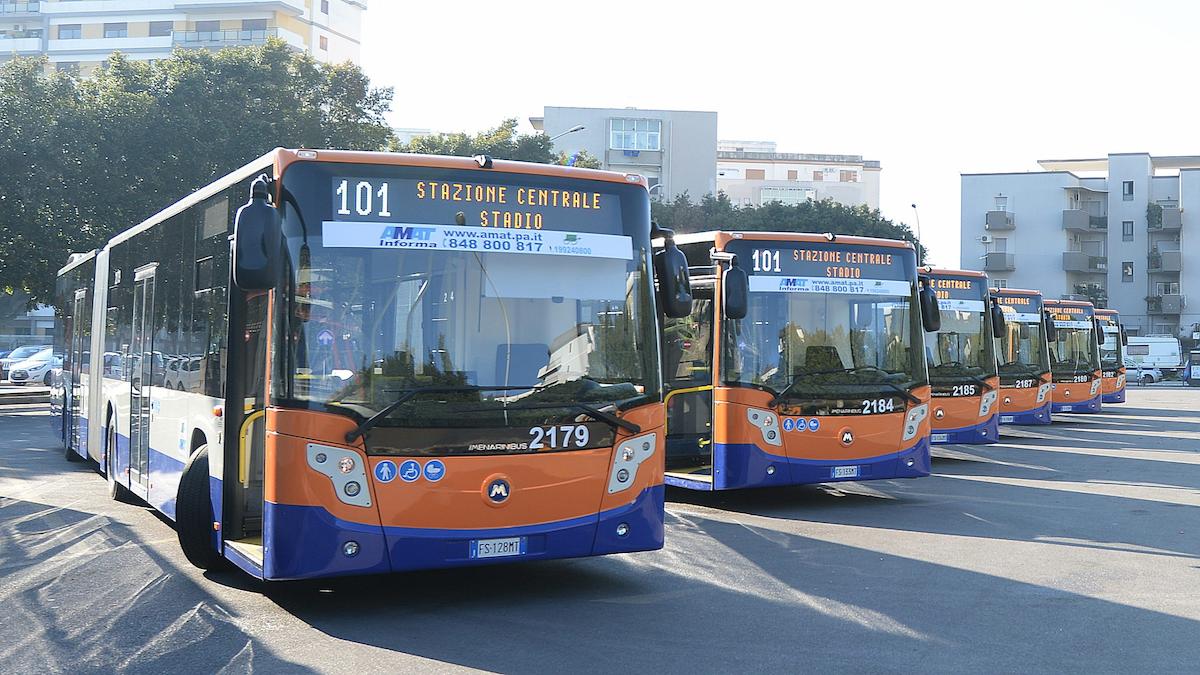
        <content type="html"><![CDATA[<div style="text-align:center"><img src="https://docs.mative.ai/img/blog/amat_palermo.jpg" alt="Orange and blue AMAT Palermo city buses parked in a row" style="width:100%;height:auto"></div>
<h2 class="anchor anchorTargetStickyNavbar_Vzrq" id="sos-panic-button-technology-protecting-drivers-operators-and-citizens">SOS Panic Button: Technology Protecting Drivers, Operators and Citizens<a href="https://docs.mative.ai/blog/2026/06/09/2026/sos-panic-button-public-transport-safety/#sos-panic-button-technology-protecting-drivers-operators-and-citizens" class="hash-link" aria-label="Direct link to SOS Panic Button: Technology Protecting Drivers, Operators and Citizens" title="Direct link to SOS Panic Button: Technology Protecting Drivers, Operators and Citizens" translate="no">​</a></h2>
<h2 class="anchor anchorTargetStickyNavbar_Vzrq" id="safety-in-public-transportation-has-become-a-priority">Safety in Public Transportation Has Become a Priority<a href="https://docs.mative.ai/blog/2026/06/09/2026/sos-panic-button-public-transport-safety/#safety-in-public-transportation-has-become-a-priority" class="hash-link" aria-label="Direct link to Safety in Public Transportation Has Become a Priority" title="Direct link to Safety in Public Transportation Has Become a Priority" translate="no">​</a></h2>
<p>Over the last decade, public transportation operators have faced increasing challenges related to staff and passenger safety.</p>
<p>Driver assaults, onboard emergencies, medical incidents and security threats require faster response times and more effective coordination between vehicles, control centers and emergency services.</p>
<p>Modern IoT and AIoT technologies provide new opportunities to improve safety and operational resilience.</p>
<p>Among these solutions, the <strong>SOS Panic Button</strong> developed by Mative offers an advanced emergency management platform designed for public transportation companies, mobility operators, public administrations and organizations requiring reliable emergency response systems.</p>
<hr>
<h2 class="anchor anchorTargetStickyNavbar_Vzrq" id="what-is-the-sos-panic-button">What is the SOS Panic Button?<a href="https://docs.mative.ai/blog/2026/06/09/2026/sos-panic-button-public-transport-safety/#what-is-the-sos-panic-button" class="hash-link" aria-label="Direct link to What is the SOS Panic Button?" title="Direct link to What is the SOS Panic Button?" translate="no">​</a></h2>
<p>The SOS Panic Button is an intelligent emergency system installed onboard vehicles that allows operators to request immediate assistance through a dedicated emergency button.</p>
<p>Once activated, the system can:</p>
<ul>
<li class="">automatically call predefined emergency contacts;</li>
<li class="">transmit real-time GPS location;</li>
<li class="">identify the involved vehicle;</li>
<li class="">notify the operations center;</li>
<li class="">trigger emergency management workflows.</li>
</ul>
<p>The objective is to reduce response times and provide emergency coordinators with immediate situational awareness.</p>
<hr>
<h2 class="anchor anchorTargetStickyNavbar_Vzrq" id="integration-with-the-european-emergency-number-112">Integration with the European Emergency Number 112<a href="https://docs.mative.ai/blog/2026/06/09/2026/sos-panic-button-public-transport-safety/#integration-with-the-european-emergency-number-112" class="hash-link" aria-label="Direct link to Integration with the European Emergency Number 112" title="Direct link to Integration with the European Emergency Number 112" translate="no">​</a></h2>
<p>One of the most valuable features of the platform is its ability to interoperate with emergency response infrastructures associated with the European Emergency Number (112).</p>
<p>Through integration with "Where ARE U" services and authorized emergency communication interfaces, the platform can securely share real-time location information during critical events.</p>
<p>This enables:</p>
<ul>
<li class="">improved location accuracy;</li>
<li class="">faster emergency response;</li>
<li class="">real-time situational updates;</li>
<li class="">better coordination between transportation operators and emergency services.</li>
</ul>
<hr>
<h2 class="anchor anchorTargetStickyNavbar_Vzrq" id="lone-worker-protection-devices">Lone Worker Protection Devices<a href="https://docs.mative.ai/blog/2026/06/09/2026/sos-panic-button-public-transport-safety/#lone-worker-protection-devices" class="hash-link" aria-label="Direct link to Lone Worker Protection Devices" title="Direct link to Lone Worker Protection Devices" translate="no">​</a></h2>
<p>The SOS Panic Button ecosystem can also be extended through wearable Lone Worker protection devices.</p>
<p>These devices are particularly suitable for:</p>
<ul>
<li class="">field technicians;</li>
<li class="">maintenance personnel;</li>
<li class="">security operators;</li>
<li class="">utility workers;</li>
<li class="">isolated workers.</li>
</ul>
<p>Equipped with GPS positioning, rechargeable batteries and intelligent motion sensors, they can automatically detect potentially dangerous situations.</p>
<h3 class="anchor anchorTargetStickyNavbar_Vzrq" id="man-down-detection">Man Down Detection<a href="https://docs.mative.ai/blog/2026/06/09/2026/sos-panic-button-public-transport-safety/#man-down-detection" class="hash-link" aria-label="Direct link to Man Down Detection" title="Direct link to Man Down Detection" translate="no">​</a></h3>
<p>The device detects falls or abnormal body positions and automatically generates an emergency alert.</p>
<h3 class="anchor anchorTargetStickyNavbar_Vzrq" id="no-movement-detection">No Movement Detection<a href="https://docs.mative.ai/blog/2026/06/09/2026/sos-panic-button-public-transport-safety/#no-movement-detection" class="hash-link" aria-label="Direct link to No Movement Detection" title="Direct link to No Movement Detection" translate="no">​</a></h3>
<p>If prolonged inactivity is detected, the system can identify potential medical emergencies or incapacitation and initiate an automatic alarm procedure.</p>
<hr>
<h2 class="anchor anchorTargetStickyNavbar_Vzrq" id="amat-palermo-case-study">AMAT Palermo Case Study<a href="https://docs.mative.ai/blog/2026/06/09/2026/sos-panic-button-public-transport-safety/#amat-palermo-case-study" class="hash-link" aria-label="Direct link to AMAT Palermo Case Study" title="Direct link to AMAT Palermo Case Study" translate="no">​</a></h2>
<p>A significant reference project is represented by AMAT Palermo, the public transportation operator serving the city of Palermo, Italy.</p>
<p>Over the years, AMAT has demonstrated a strong commitment to employee safety through investments in:</p>
<ul>
<li class="">onboard video surveillance systems;</li>
<li class="">anti-aggression driver protection solutions;</li>
<li class="">fleet monitoring technologies;</li>
<li class="">advanced emergency management tools.</li>
</ul>
<p>The adoption of the SOS Panic Button platform developed by Mative further strengthens this strategy.</p>
<p>The project demonstrates how digital technologies can provide tangible benefits in protecting transportation personnel while supporting service continuity.</p>
<hr>
<h2 class="anchor anchorTargetStickyNavbar_Vzrq" id="safety-as-a-strategic-business-asset">Safety as a Strategic Business Asset<a href="https://docs.mative.ai/blog/2026/06/09/2026/sos-panic-button-public-transport-safety/#safety-as-a-strategic-business-asset" class="hash-link" aria-label="Direct link to Safety as a Strategic Business Asset" title="Direct link to Safety as a Strategic Business Asset" translate="no">​</a></h2>
<p>Today, safety should not be viewed merely as a regulatory requirement.</p>
<p>For transportation companies, municipalities and public service organizations, safety has become a strategic asset capable of improving:</p>
<ul>
<li class="">operational continuity;</li>
<li class="">service quality;</li>
<li class="">workforce protection;</li>
<li class="">risk management;</li>
<li class="">corporate reputation;</li>
<li class="">organizational resilience.</li>
</ul>
<p>Real-time monitoring, IoT technologies and emergency integration platforms help organizations create safer environments for both workers and citizens.</p>
<hr>
<h2 class="anchor anchorTargetStickyNavbar_Vzrq" id="the-mative-approach">The Mative Approach<a href="https://docs.mative.ai/blog/2026/06/09/2026/sos-panic-button-public-transport-safety/#the-mative-approach" class="hash-link" aria-label="Direct link to The Mative Approach" title="Direct link to The Mative Approach" translate="no">​</a></h2>
<p>Mative develops advanced AIoT solutions for safety, monitoring and intelligent asset management.</p>
<p>The SOS Panic Button ecosystem combines IoT devices, cloud platforms, telemetry, GPS tracking and emergency response technologies into a scalable and interoperable architecture.</p>
<p>Our mission is clear: leverage technology to protect people, accelerate emergency response and improve safety across public and private services.</p>
<p><strong>Learn more at <a href="https://www.mative.ai/en" target="_blank" rel="noopener noreferrer" class="">www.mative.ai</a></strong></p>
<h2 class="anchor anchorTargetStickyNavbar_Vzrq" id="learn-more">Learn more<a href="https://docs.mative.ai/blog/2026/06/09/2026/sos-panic-button-public-transport-safety/#learn-more" class="hash-link" aria-label="Direct link to Learn more" title="Direct link to Learn more" translate="no">​</a></h2>
<ul>
<li class=""><a class="" href="https://docs.mative.ai/blog/2024/08/01/2024/report-p-transport-company/">IoT &amp; ML: Energy and Economic Benefits in a Public Transport Company</a></li>
<li class=""><a class="" href="https://docs.mative.ai/blog/2026/06/01/2026/ai-accident-reconstruction/">AI Accident Reconstruction</a></li>
<li class=""><a class="" href="https://docs.mative.ai/docs/category/gps-trackers/">GPS Trackers</a></li>
<li class=""><a href="https://www.mative.ai/en/industries/public-transport" target="_blank" rel="noopener noreferrer" class="">Mative solutions for public transport</a></li>
</ul>]]></content>
        <author>
            <name>Gianmaria Meriano</name>
            <uri>https://www.linkedin.com/in/gianmaria-meriano/</uri>
        </author>
        <category label="iot" term="iot"/>
        <category label="safety" term="safety"/>
        <category label="public transport" term="public transport"/>
        <category label="geolocation" term="geolocation"/>
        <category label="emergency management" term="emergency management"/>
        <category label="nue112" term="nue112"/>
        <category label="where_are_u" term="where_are_u"/>
        <category label="smart mobility" term="smart mobility"/>
        <category label="aiot" term="aiot"/>
        <category label="lone_worker" term="lone_worker"/>
    </entry>
    <entry>
        <title type="html"><![CDATA[AI Accident Reconstruction]]></title>
        <id>https://docs.mative.ai/blog/2026/06/01/2026/ai-accident-reconstruction/</id>
        <link href="https://docs.mative.ai/blog/2026/06/01/2026/ai-accident-reconstruction/"/>
        <updated>2026-06-01T00:00:00.000Z</updated>
        <summary type="html"><![CDATA[How Mative transforms raw telematics data into immediate impact reports through the synergy of Machine Learning and LLMs.]]></summary>
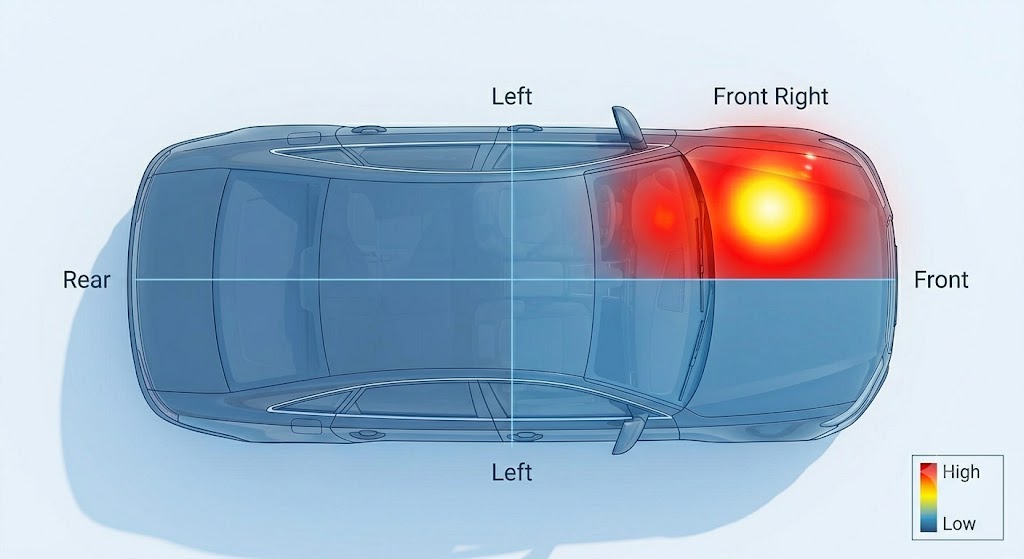
        <content type="html"><![CDATA[<div style="text-align:center"><img src="https://docs.mative.ai/img/blog/ai_accident_analysis.jpg" alt="Top view of a car with an impact heatmap concentrated on the front-right side" style="width:100%;height:auto"></div>
<h2 class="anchor anchorTargetStickyNavbar_Vzrq" id="ai-accident-reconstruction">AI Accident Reconstruction<a href="https://docs.mative.ai/blog/2026/06/01/2026/ai-accident-reconstruction/#ai-accident-reconstruction" class="hash-link" aria-label="Direct link to AI Accident Reconstruction" title="Direct link to AI Accident Reconstruction" translate="no">​</a></h2>
<p>In the high-stakes sectors of car rental and commercial fleet management, there is a critical moment that every operator dreads: receiving an accident alert. In that exact millisecond, complex questions arise: <em>What is the extent of the damage? Who is at fault? Can the vehicle safely continue its journey?</em></p>
<p>Until recently, the answers relied on rushed paperwork, conflicting driver statements, or complex, raw telemetry logs that took days for specialized engineers to interpret.</p>
<p>Today, <a href="https://www.mative.ai/en" target="_blank" rel="noopener noreferrer" class=""><strong>Mative</strong></a> is redefining industry standards. We have developed an intelligent architecture capable of transforming invisible vehicle vibrations into a crystal-clear, objective impact report available in real time.</p>
<hr>
<h2 class="anchor anchorTargetStickyNavbar_Vzrq" id="behind-the-scenes-how-mative-technology-works">Behind the Scenes: How Mative Technology Works<a href="https://docs.mative.ai/blog/2026/06/01/2026/ai-accident-reconstruction/#behind-the-scenes-how-mative-technology-works" class="hash-link" aria-label="Direct link to Behind the Scenes: How Mative Technology Works" title="Direct link to Behind the Scenes: How Mative Technology Works" translate="no">​</a></h2>
<p>Traditional telematics systems rely purely on fixed deceleration thresholds (G-force). This approach frequently generates false positives—hitting a deep pothole or speeding over a speed bump can trigger false alarms, overwhelming fleet managers.</p>
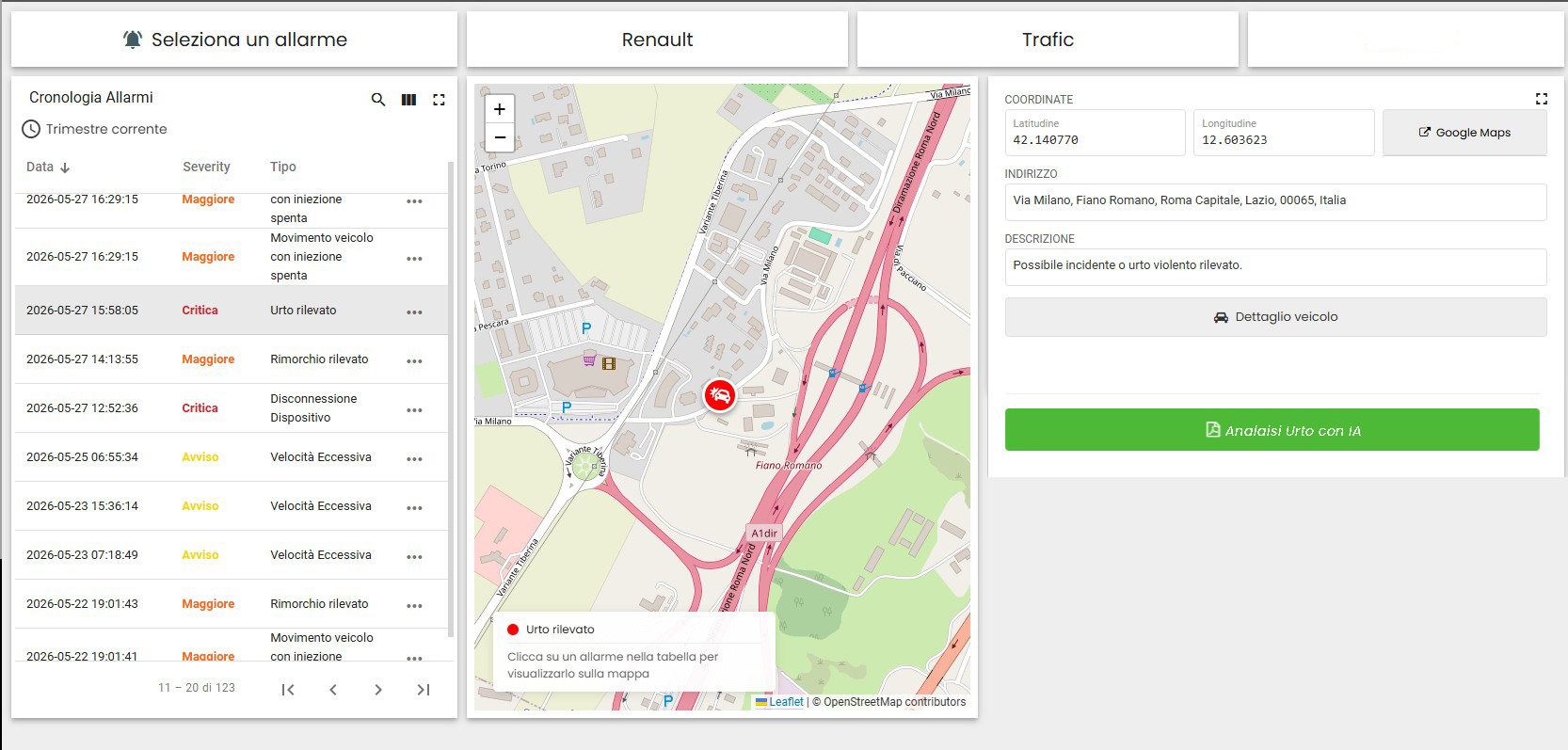
<div style="text-align:center"><img src="https://docs.mative.ai/img/blog/ai_accident_dashboard.jpg" alt="Alarm dashboard showing a Renault Trafic impact on the map and an AI analysis button" style="width:100%;height:auto"></div>
<p>The <strong><a class="" href="https://docs.mative.ai/docs/Technology/Mative%20Cloud/mative_cloud/">Mative Cloud</a></strong> ecosystem operates on a radically superior level, structured across three key phases:</p>
<h3 class="anchor anchorTargetStickyNavbar_Vzrq" id="1-the-challenge-decoding-accelerometer-noise">1. The Challenge: Decoding Accelerometer Noise<a href="https://docs.mative.ai/blog/2026/06/01/2026/ai-accident-reconstruction/#1-the-challenge-decoding-accelerometer-noise" class="hash-link" aria-label="Direct link to 1. The Challenge: Decoding Accelerometer Noise" title="Direct link to 1. The Challenge: Decoding Accelerometer Noise" translate="no">​</a></h3>
<p>Every GPS tracking device installed inside a vehicle is equipped with a triaxial accelerometer. This sensor constantly records acceleration forces along three vector axes:</p>
<ul>
<li class=""><strong>X-Axis:</strong> Longitudinal acceleration (sudden braking and harsh acceleration).</li>
<li class=""><strong>Y-Axis:</strong> Lateral acceleration (sharp cornering, swerving, or sideways impacts).</li>
<li class=""><strong>Z-Axis:</strong> Vertical acceleration (potholes, speed bumps, or road surface changes).</li>
</ul>
<p>When a collision occurs, the device sends an "impact alert" to the cloud platform, accompanied by a string of raw G-force data. To the human eye, this data is just an unreadable jumble of numbers and erratic graphs. Mative Cloud intervenes by isolating a targeted ±5-minute time window around the event to capture the exact pre- and post-impact kinematics.</p>
<hr>
<h3 class="anchor anchorTargetStickyNavbar_Vzrq" id="2-the-mathematical-brain-machine-learning-for-localization">2. The Mathematical Brain: Machine Learning for Localization<a href="https://docs.mative.ai/blog/2026/06/01/2026/ai-accident-reconstruction/#2-the-mathematical-brain-machine-learning-for-localization" class="hash-link" aria-label="Direct link to 2. The Mathematical Brain: Machine Learning for Localization" title="Direct link to 2. The Mathematical Brain: Machine Learning for Localization" translate="no">​</a></h3>
<p>This is where our <strong>Machine Learning</strong> model comes into play: a <em>Random Forest Classifier</em> built with 100 parallel estimators and trained on vast datasets of crash kinematics. The core strength of the model lies in its <em>Feature Engineering</em> stage. Instead of just looking at an isolated G-force peak, Mative's pipeline extracts advanced mathematical indicators from the signal: net magnitude, continuous power (RMS), wave integrals, longitudinal-to-lateral force ratios, and the estimated angle of impact.</p>
<p>By analyzing this structural "energy signature", the algorithm recognizes the physical dynamics of the event within milliseconds, precisely classifying the direction of the blow and mapping the car into physical quadrants (Front, Rear, Left Side, Right Side) with an accuracy exceeding 95%.</p>
<hr>
<h3 class="anchor anchorTargetStickyNavbar_Vzrq" id="3-the-human-voice-llms-translate-numbers-into-narrative">3. The Human Voice: LLMs Translate Numbers into Narrative<a href="https://docs.mative.ai/blog/2026/06/01/2026/ai-accident-reconstruction/#3-the-human-voice-llms-translate-numbers-into-narrative" class="hash-link" aria-label="Direct link to 3. The Human Voice: LLMs Translate Numbers into Narrative" title="Direct link to 3. The Human Voice: LLMs Translate Numbers into Narrative" translate="no">​</a></h3>
<p>Identifying the point of impact with mathematical precision is a major breakthrough, but a raw JSON string or a vector chart isn't immediately helpful to an insurance adjuster or a busy desk operator at a car rental station. It requires an accessible, easy-to-understand explanation.</p>
<p>To bridge this gap, we integrated an <strong>LLM (Large Language Model)</strong> directly into our reporting pipeline. The LLM acts as the ultimate translator, turning the objective output of the Machine Learning classifier into a natural, logical, and professional narrative. Because it is strictly anchored to the verified mathematical calculations validated by the Random Forest, it eliminates any risk of narrative "hallucinations."</p>
<blockquote>
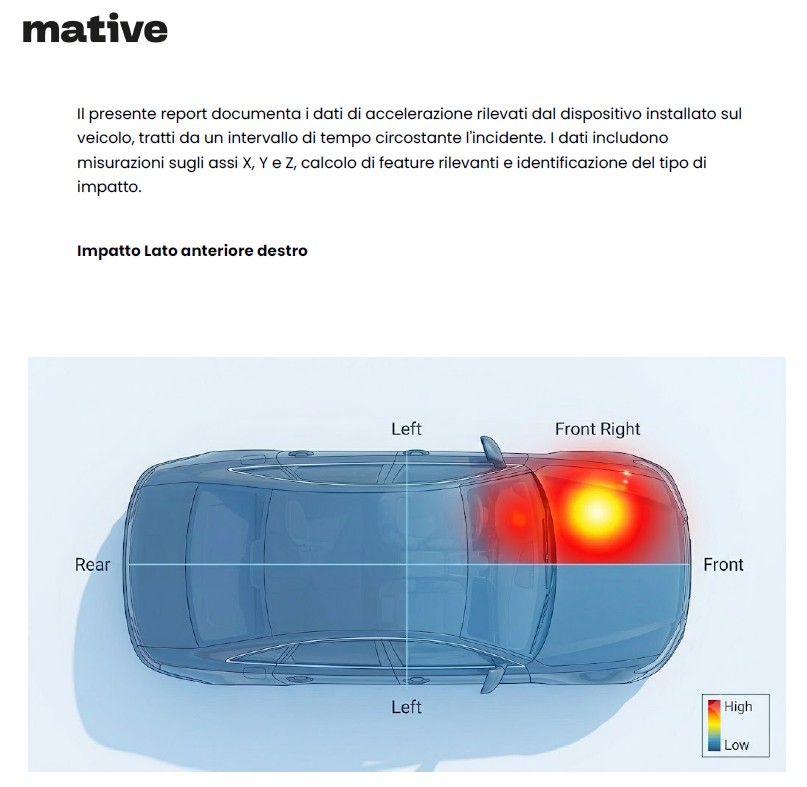
<p><strong>Example of an Automated Mative Report Summary:</strong>
<em>"Mative Cloud detected a high-energy structural anomaly. Our predictive model classified a severe impact localized on the <strong>front-right side</strong> of the vehicle. The force vector distribution suggests an oblique collision with a partially static obstacle during a turning maneuver."</em></p>
</blockquote>
<div style="text-align:center"><img src="https://docs.mative.ai/img/blog/report_ai_accident_details.jpg" alt="Mative accident report stating a front-right impact, with a heatmap on the car top view" style="width:100%;height:auto"></div>
<hr>
<h2 class="anchor anchorTargetStickyNavbar_Vzrq" id="a-game-changer-for-car-rental-and-fleet-operations">A Game-Changer for Car Rental and Fleet Operations<a href="https://docs.mative.ai/blog/2026/06/01/2026/ai-accident-reconstruction/#a-game-changer-for-car-rental-and-fleet-operations" class="hash-link" aria-label="Direct link to A Game-Changer for Car Rental and Fleet Operations" title="Direct link to A Game-Changer for Car Rental and Fleet Operations" translate="no">​</a></h2>
<p>Why is this technology developed by Mative so vital for vehicle operators?</p>
<ul>
<li class=""><strong>Eliminate Hidden Damage:</strong> Renters often return vehicles without mentioning minor collisions or structural impacts to lower components (like suspension arms or underbody shielding). With Mative, car rental operators know exactly if and where a vehicle suffered a blow during the rental period, enabling them to address damages with objective, digital proof at check-out.</li>
<li class=""><strong>Minimize Vehicle Downtime:</strong> Knowing the exact side and severity of the impact immediately allows operators to order spare parts and schedule workshop repairs before the car even returns to the yard, optimizing fleet logistics and reducing lost revenue days.</li>
<li class=""><strong>Fraud Prevention &amp; Legal Protection:</strong> In disputed insurance cases, the Mative report provides an unalterable, scientific reconstruction of the crash physics. It is impossible to claim rear-end damage when sensors certify a front-end impact. This accelerates claims resolution and safeguards assets against fraudulent demands.</li>
</ul>
<p>Telematics is no longer just about tracking physical locations; with Mative, it becomes a contextual understanding of asset health. The future of intelligent vehicle monitoring is here, and it is driven by data.</p>
<h2 class="anchor anchorTargetStickyNavbar_Vzrq" id="learn-more">Learn more<a href="https://docs.mative.ai/blog/2026/06/01/2026/ai-accident-reconstruction/#learn-more" class="hash-link" aria-label="Direct link to Learn more" title="Direct link to Learn more" translate="no">​</a></h2>
<ul>
<li class=""><a class="" href="https://docs.mative.ai/blog/2024/03/25/2024/driver-insurance/">Driver Insurance</a></li>
<li class=""><a class="" href="https://docs.mative.ai/blog/2024/03/25/2024/car-rental/">Car Rental and Software Solutions</a></li>
<li class=""><a class="" href="https://docs.mative.ai/blog/2024/03/25/2024/ml-service-anomalies/">Anomalies detection</a></li>
<li class=""><a class="" href="https://docs.mative.ai/docs/Technology/Synapsis%20ML/Large%20Language%20Models/What%20are%20the%20Large%20Language%20Models/">What are the Large Language Models</a></li>
<li class=""><a href="https://www.mative.ai/en/products/artificial-intelligence" target="_blank" rel="noopener noreferrer" class="">Mative Artificial Intelligence</a></li>
</ul>]]></content>
        <author>
            <name>Gianmaria Meriano</name>
            <uri>https://www.linkedin.com/in/gianmaria-meriano/</uri>
        </author>
        <category label="iot" term="iot"/>
        <category label="telemetry" term="telemetry"/>
        <category label="edge computing" term="edge computing"/>
        <category label="logistics" term="logistics"/>
        <category label="asset tracking" term="asset tracking"/>
        <category label="artificial intelligence" term="artificial intelligence"/>
        <category label="machine learning" term="machine learning"/>
        <category label="insurtech" term="insurtech"/>
        <category label="smart mobility" term="smart mobility"/>
    </entry>
    <entry>
        <title type="html"><![CDATA[Mative’s solution for on-board load weight measurement]]></title>
        <id>https://docs.mative.ai/blog/2026/04/24/2026/weight-measurement/</id>
        <link href="https://docs.mative.ai/blog/2026/04/24/2026/weight-measurement/"/>
        <updated>2026-05-21T00:00:00.000Z</updated>
        <summary type="html"><![CDATA[On-board load weight measurement with an angular sensor on the axle: how it works, calibration at a weighbridge, 3–5% accuracy and data sent to Mative Cloud.]]></summary>
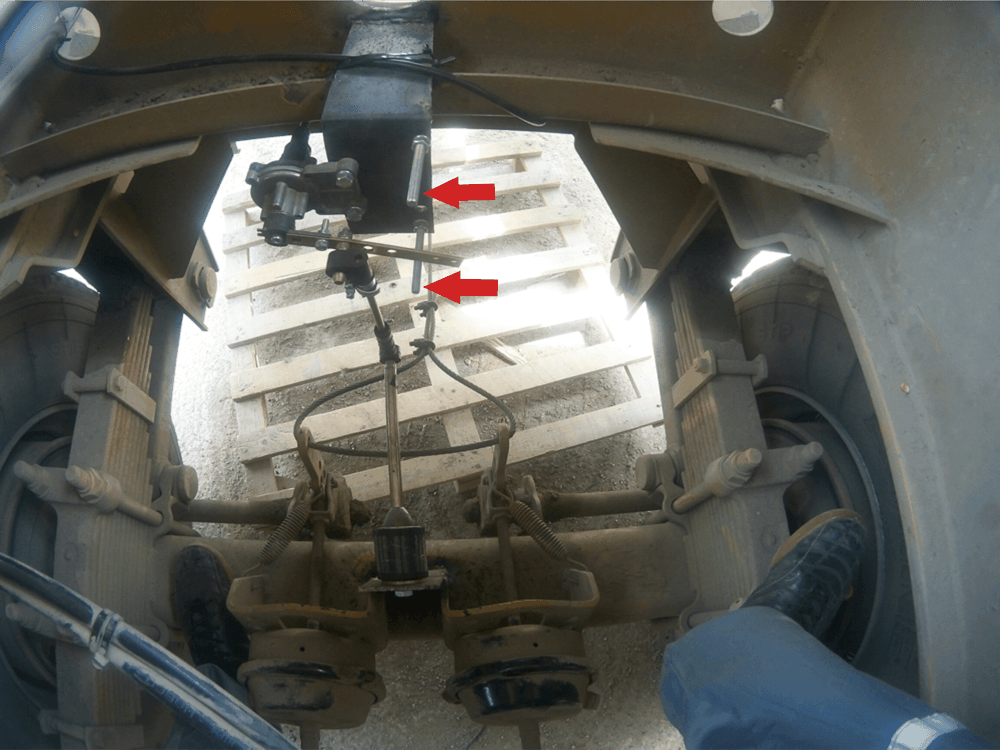
        <content type="html"><![CDATA[<div style="text-align:center"><img src="https://docs.mative.ai/img/blog/axle_load_sensor.png" alt="Angular sensor and linkage rod between truck chassis and rear axle, marked by red arrows" style="width:100%;height:auto"></div>
<h2 class="anchor anchorTargetStickyNavbar_Vzrq" id="mative-on-board-load-weight-measurement-solution-iot-and-angular-sensors-for-advanced-logistics">Mative On-Board Load Weight Measurement Solution: IoT and Angular Sensors for Advanced Logistics<a href="https://docs.mative.ai/blog/2026/04/24/2026/weight-measurement/#mative-on-board-load-weight-measurement-solution-iot-and-angular-sensors-for-advanced-logistics" class="hash-link" aria-label="Direct link to Mative On-Board Load Weight Measurement Solution: IoT and Angular Sensors for Advanced Logistics" title="Direct link to Mative On-Board Load Weight Measurement Solution: IoT and Angular Sensors for Advanced Logistics" translate="no">​</a></h2>
<p>In modern logistics, transport, and industrial fleet management, accurate measurement of transported payload has evolved from a simple operational choice to a critical business function. Lacking real-time visibility into vehicle load leads to severe operational risks: overloading penalties, premature wear of tires and mechanical components, exponential increases in fuel consumption, compromised road safety, and logistical inefficiencies like under-utilized trips.</p>
<p>Traditionally, the market has addressed this need by installing load cells directly into the vehicle suspension or by relying exclusively on external static weighbridges. Although effective, these solutions involve high structural costs, prolonged vehicle downtime during installation, and significant vulnerability to the mechanical and environmental shocks typical of construction sites or quarries.</p>
<p>However, an alternative approach engineered by <strong>Mative</strong> proves to be highly pragmatic, robust, and cost-effective: transforming the vehicle's own structure into a natural sensor by leveraging the mechanical micro-deformation of the chassis and suspension system.</p>
<div class="theme-admonition theme-admonition-info admonition_xJq3 alert alert--info"><div class="admonitionHeading_Gvgb"><span class="admonitionIcon_Rf37"><svg viewBox="0 0 14 16"><path fill-rule="evenodd" d="M7 2.3c3.14 0 5.7 2.56 5.7 5.7s-2.56 5.7-5.7 5.7A5.71 5.71 0 0 1 1.3 8c0-3.14 2.56-5.7 5.7-5.7zM7 1C3.14 1 0 4.14 0 8s3.14 7 7 7 7-3.14 7-7-3.14-7-7-7zm1 3H6v5h2V4zm0 6H6v2h2v-2z"></path></svg></span>TAX INCENTIVES: ITALY'S TRANSIZIONE 4.0</div><div class="admonitionContent_BuS1"><p><strong>Did you know that the Mative on-board weighing solution fully complies with the requirements of the Italian "Piano Transizione 4.0"?</strong> Thanks to native integration with industrial telematics trackers and bidirectional interconnection with the <strong>Mative Cloud</strong> platform, this investment qualifies your new industrial vehicles and machinery for the <strong>4.0 Tax Credit</strong> (under Annex A of Law 232/2016 for weighing and material handling devices). This is a tangible opportunity to digitize your logistics while drastically cutting implementation costs. <strong><a href="https://www.mative.ai/en/contact" target="_blank" rel="noopener noreferrer" class="">Contact us for more details and to receive technical support on regulatory compliance.</a></strong></p></div></div>
<hr>
<h2 class="anchor anchorTargetStickyNavbar_Vzrq" id="the-physical-principle-the-chassis-as-a-natural-sensor">The Physical Principle: The Chassis as a Natural Sensor<a href="https://docs.mative.ai/blog/2026/04/24/2026/weight-measurement/#the-physical-principle-the-chassis-as-a-natural-sensor" class="hash-link" aria-label="Direct link to The Physical Principle: The Chassis as a Natural Sensor" title="Direct link to The Physical Principle: The Chassis as a Natural Sensor" translate="no">​</a></h2>
<p>From a materials science perspective, every industrial vehicle obeys the laws of linear elasticity (Hooke's Law). When a load is placed on a truck bed, the chassis and suspension system (whether mechanical leaf springs or pneumatic systems) undergo compression and elastic deformation directly proportional to the applied mass.</p>
<p>This vertical deformation translates into a macroscopic alteration of the alignment and relative distance between the fixed chassis (upper frame rails) and the rear axles (unsprung mass).</p>
<p>While traditional systems try to measure vertical force directly (compression), the Mative solution interprets this geometric variation as a <strong>relative angular rotation</strong>. The heavier the payload, the greater the vertical deflection of the suspension system, and consequently, the wider the geometric angle measured by the mechanical linkage connected to the sensor.</p>
<hr>
<h2 class="anchor anchorTargetStickyNavbar_Vzrq" id="the-technological-solution-angular-sensor--mechanical-linkage">The Technological Solution: Angular Sensor + Mechanical Linkage<a href="https://docs.mative.ai/blog/2026/04/24/2026/weight-measurement/#the-technological-solution-angular-sensor--mechanical-linkage" class="hash-link" aria-label="Direct link to The Technological Solution: Angular Sensor + Mechanical Linkage" title="Direct link to The Technological Solution: Angular Sensor + Mechanical Linkage" translate="no">​</a></h2>
<p>The hardware system developed by Mative stands out for its structural simplicity, minimizing potential mechanical and electrical failure points. It consists of two key components:</p>
<h3 class="anchor anchorTargetStickyNavbar_Vzrq" id="1-industrial-grade-analog-angular-sensor">1. Industrial-Grade Analog Angular Sensor<a href="https://docs.mative.ai/blog/2026/04/24/2026/weight-measurement/#1-industrial-grade-analog-angular-sensor" class="hash-link" aria-label="Direct link to 1. Industrial-Grade Analog Angular Sensor" title="Direct link to 1. Industrial-Grade Analog Angular Sensor" translate="no">​</a></h3>
<p>A high-precision rotary Hall-effect or potentiometric sensor is used, enclosed in a rugged, waterproof housing with an IP67/IP69K protection rating (resistant to water, mud, and fine dust). Installed on the vehicle's fixed chassis, it outputs a standardized analog signal (0–5V or 0–10V) featuring high immunity to electromagnetic interference.</p>
<h3 class="anchor anchorTargetStickyNavbar_Vzrq" id="2-linkage-and-mechanical-rod-structure">2. Linkage and Mechanical Rod Structure<a href="https://docs.mative.ai/blog/2026/04/24/2026/weight-measurement/#2-linkage-and-mechanical-rod-structure" class="hash-link" aria-label="Direct link to 2. Linkage and Mechanical Rod Structure" title="Direct link to 2. Linkage and Mechanical Rod Structure" translate="no">​</a></h3>
<p>An articulated metal rod equipped with spherical joints (uniball) connects the wheel axle to the sensor lever. This linkage plays a crucial role:</p>
<ul>
<li class=""><strong>Axles (Input):</strong> Experience vertical movement due to loading operations and road roughness.</li>
<li class=""><strong>Connecting Rod (Conversion):</strong> Transforms linear vertical displacement into pure rotational movement.</li>
<li class=""><strong>Sensor (Output):</strong> Reads the angular variation in degrees or radians, instantly translating it into electrical voltage.</li>
</ul>
<div style="text-align:center"><img src="https://docs.mative.ai/img/blog/axle_load_sensor_2.png" alt="Ball-jointed rod linking the chassis sensor to the leaf spring axle, highlighted in red" style="width:100%;height:auto"></div>
<hr>
<h2 class="anchor anchorTargetStickyNavbar_Vzrq" id="on-board-intelligence-signal-processing-and-edge-computing">On-Board Intelligence: Signal Processing and Edge Computing<a href="https://docs.mative.ai/blog/2026/04/24/2026/weight-measurement/#on-board-intelligence-signal-processing-and-edge-computing" class="hash-link" aria-label="Direct link to On-Board Intelligence: Signal Processing and Edge Computing" title="Direct link to On-Board Intelligence: Signal Processing and Edge Computing" translate="no">​</a></h2>
<p>The raw analog signal generated by the sensor would be useless without on-board processing and digitization. The electrical voltage is captured by an <strong>industrial telematics tracker (IoT Gateway)</strong> installed inside the cabin.</p>
<p>The tracker does not merely digitize the signal (via a 10 or 12-bit Analog-to-Digital conversion), but performs complex <em>Edge Computing</em> tasks:</p>
<ul>
<li class=""><strong>Dynamic Filtering:</strong> On-board software applies moving average algorithms or low-pass filters to eliminate "noise" and sudden oscillations caused by potholes, speed bumps, or braking while driving.</li>
<li class=""><strong>Data Enrichment:</strong> The weight value (or current angle) is sampled and instantly cross-referenced with GPS coordinates, vehicle speed, engine status (ON/OFF), and timestamps.</li>
<li class=""><strong>Smart Transmission:</strong> Data packets are optimized and transmitted to the Cloud infrastructure via cellular networks (4G/5G/LTE-M), ensuring connectivity even in low-coverage areas.</li>
</ul>
<hr>
<h2 class="anchor anchorTargetStickyNavbar_Vzrq" id="end-to-end-iot-architecture">End-to-End IoT Architecture<a href="https://docs.mative.ai/blog/2026/04/24/2026/weight-measurement/#end-to-end-iot-architecture" class="hash-link" aria-label="Direct link to End-to-End IoT Architecture" title="Direct link to End-to-End IoT Architecture" translate="no">​</a></h2>
<p>The data flow of the Mative solution follows a structured 5-layer IoT architecture, ensuring raw data is successfully turned into actionable insights for the Fleet Manager:</p>
<ol>
<li class=""><strong>Angular Sensor (Edge Hardware):</strong> Detects mechanical deformation and generates voltage variation (0-5V / 0-10V).</li>
<li class=""><strong>Telematics Tracker (Edge Computing):</strong> Acquires the signal, applies stabilization filters, appends geolocational data, and digitizes the packet.</li>
<li class=""><strong>Cellular Network (Connectivity):</strong> Safely transports data, encrypting it via industrial IoT protocols (e.g., MQTT, CoAP, or HTTPS).</li>
<li class=""><strong><a class="" href="https://docs.mative.ai/docs/category/synapsis-iot/">Synapsis IoT</a> by Mative (Cloud Data Bridge):</strong> Backend layer responsible for massive data ingestion, real-time buffering, and applying the mathematical conversion models (calibration).</li>
<li class=""><strong><a class="" href="https://docs.mative.ai/docs/category/mative-cloud/">Mative Cloud</a> (Dashboard &amp; Analytics):</strong> The application front-end where the end user views data through intuitive charts, receives real-time alerts on overload attempts, and generates advanced fleet efficiency reports.</li>
</ol>
<hr>
<h2 class="anchor anchorTargetStickyNavbar_Vzrq" id="the-calibration-process-and-linear-accuracy">The Calibration Process and Linear Accuracy<a href="https://docs.mative.ai/blog/2026/04/24/2026/weight-measurement/#the-calibration-process-and-linear-accuracy" class="hash-link" aria-label="Direct link to The Calibration Process and Linear Accuracy" title="Direct link to The Calibration Process and Linear Accuracy" translate="no">​</a></h2>
<p>Because every vehicle possesses unique structural rigidity and elastic responses, the system's accuracy relies on an initial calibration phase, managed entirely through software algorithms within the Mative cloud:</p>
<ol>
<li class=""><strong>Tare Point (Empty Vehicle):</strong> The minimum voltage emitted by the sensor when the vehicle is completely empty is recorded.</li>
<li class=""><strong>Known Load Points:</strong> Intermediate and full-load weighings are carried out at a certified public weighbridge, storing the corresponding voltage values.</li>
<li class=""><strong>Angle-to-Weight Conversion Curve:</strong> The cloud algorithm processes these reference points to generate a custom mathematical regression curve for that specific vehicle.</li>
</ol>
<p><strong>Typical Accuracy:</strong> The solution guarantees an accuracy range between <strong>3% and 5% of the maximum payload</strong>. This margin of error is ideal for remote logistics monitoring, delivering excellent visibility without the prohibitive costs of commercial-grade certified load cells.</p>
<hr>
<h2 class="anchor anchorTargetStickyNavbar_Vzrq" id="ideal-application-fields">Ideal Application Fields<a href="https://docs.mative.ai/blog/2026/04/24/2026/weight-measurement/#ideal-application-fields" class="hash-link" aria-label="Direct link to Ideal Application Fields" title="Direct link to Ideal Application Fields" translate="no">​</a></h2>
<p>This technology delivers its highest value in demanding operational environments where traditional weighing systems would suffer frequent breakdowns:</p>
<ul>
<li class=""><strong>Concrete Mixers:</strong> Monitoring concrete payload and preventing solid buildup inside the mixing drum.</li>
<li class=""><strong>Tipper Trucks and Dumpers:</strong> Immediate verification during loading operations in quarries to prevent road fines.</li>
<li class=""><strong>Aggregates and Bulk Transport:</strong> Trip optimization to maximize fleet productivity without exceeding legal limits.</li>
<li class=""><strong>Construction and Municipal Fleets:</strong> Tracking the volume of materials or waste handled per job site or operational route.</li>
</ul>
<hr>
<h2 class="anchor anchorTargetStickyNavbar_Vzrq" id="competitive-advantages-of-the-mative-solution">Competitive Advantages of the Mative Solution<a href="https://docs.mative.ai/blog/2026/04/24/2026/weight-measurement/#competitive-advantages-of-the-mative-solution" class="hash-link" aria-label="Direct link to Competitive Advantages of the Mative Solution" title="Direct link to Competitive Advantages of the Mative Solution" translate="no">​</a></h2>
<ul>
<li class=""><strong>Non-Invasive, Quick Installation:</strong> Requires no structural modifications to the chassis or suspension (unlike load cells). Installation takes only a few hours, eliminating workshop downtime.</li>
<li class=""><strong>Reduced Total Cost of Ownership (TCO):</strong> Costs a fraction of traditional load cell systems, making large-scale adoption across an entire corporate fleet highly scalable.</li>
<li class=""><strong>Mechanical Robustness and Resilience:</strong> Located outside the direct load path, the sensor is protected from violent shocks caused by heavy materials dropping into the truck bed.</li>
<li class=""><strong>Native IoT Integration:</strong> Data is not isolated on an in-cab display; it is natively shared and integrated with company ERP and management software through Mative Cloud.</li>
<li class=""><strong>Minimal Maintenance:</strong> No hydraulic fluids or components under constant load stress, drastically reducing the need for recalibration or repairs.</li>
</ul>
<hr>
<h2 class="anchor anchorTargetStickyNavbar_Vzrq" id="conclusion">Conclusion<a href="https://docs.mative.ai/blog/2026/04/24/2026/weight-measurement/#conclusion" class="hash-link" aria-label="Direct link to Conclusion" title="Direct link to Conclusion" translate="no">​</a></h2>
<p>The Mative on-board load weight measurement solution proves that the Industrial Internet of Things (IIoT) must be driven by pragmatism. Instead of overloading vehicles with complex, expensive, and delicate hardware, the smarter approach is to exploit the intrinsic physical properties of the vehicle, shifting accuracy and intelligence to cloud-based software data processing.</p>
<p>Optimizing logistics, protecting corporate assets, and ensuring regulatory compliance has never been this straightforward and efficient.</p>
<h2 class="anchor anchorTargetStickyNavbar_Vzrq" id="learn-more">Learn more<a href="https://docs.mative.ai/blog/2026/04/24/2026/weight-measurement/#learn-more" class="hash-link" aria-label="Direct link to Learn more" title="Direct link to Learn more" translate="no">​</a></h2>
<ul>
<li class=""><a class="" href="https://docs.mative.ai/blog/2026/04/24/2026/excavation/">Depth Measurement System for Excavators by Mative</a></li>
<li class=""><a class="" href="https://docs.mative.ai/blog/2024/08/01/2024/report-construction-company/">IoT &amp; ML: Energy and economic benefits in a Construction Company</a></li>
<li class=""><a class="" href="https://docs.mative.ai/blog/2026/01/01/2026/waste-rfid/">How RFID Monitoring Works in Garbage Collection Trucks</a></li>
<li class=""><a class="" href="https://docs.mative.ai/docs/Technology/Mative%20Cloud/Fleet%20Management/Connectivity/fleet_management_sensors/">Sensors</a></li>
<li class=""><a href="https://www.mative.ai/en/industries/construction-heavy-equipment" target="_blank" rel="noopener noreferrer" class="">Mative solutions for construction and heavy equipment</a></li>
</ul>]]></content>
        <author>
            <name>Gianmaria Meriano</name>
            <uri>https://www.linkedin.com/in/gianmaria-meriano/</uri>
        </author>
        <category label="telemetry" term="telemetry"/>
        <category label="iot" term="iot"/>
        <category label="logistics" term="logistics"/>
        <category label="industry_40" term="industry_40"/>
    </entry>
    <entry>
        <title type="html"><![CDATA[Depth Measurement System for Excavators by Mative]]></title>
        <id>https://docs.mative.ai/blog/2026/04/24/2026/excavation/</id>
        <link href="https://docs.mative.ai/blog/2026/04/24/2026/excavation/"/>
        <updated>2026-04-24T00:00:00.000Z</updated>
        <summary type="html"><![CDATA[A depth measurement system for excavators that tracks the arm position, computes bucket depth to the centimeter in real time and sends the data to the cloud.]]></summary>
        <content type="html"><![CDATA[<div style="text-align:center"><img src="https://docs.mative.ai/img/blog/volvo_mative_sensors.jpg" alt="Position sensors on a Volvo excavator boom and stick, circled in green" style="width:100%;height:auto"></div>
<h2 class="anchor anchorTargetStickyNavbar_Vzrq" id="revolutionizing-excavation-with-data-intelligence-depth-measurement-system-for-excavators">Revolutionizing Excavation with Data Intelligence: Depth Measurement System for Excavators<a href="https://docs.mative.ai/blog/2026/04/24/2026/excavation/#revolutionizing-excavation-with-data-intelligence-depth-measurement-system-for-excavators" class="hash-link" aria-label="Direct link to Revolutionizing Excavation with Data Intelligence: Depth Measurement System for Excavators" title="Direct link to Revolutionizing Excavation with Data Intelligence: Depth Measurement System for Excavators" translate="no">​</a></h2>
<p>In the earthmoving sector, precision, execution speed, and safety are three essential elements for the competitiveness of any construction site. Even today, many excavation activities still rely on operator experience, manual checks, or external tools that slow down operations and increase margins of error.</p>
<p>From this need comes our new project: <strong>an intelligent real-time excavation depth measurement system for excavators</strong>, designed to bring practical innovation to the world of heavy machinery.</p>
<div class="theme-admonition theme-admonition-info admonition_xJq3 alert alert--info"><div class="admonitionHeading_Gvgb"><span class="admonitionIcon_Rf37"><svg viewBox="0 0 14 16"><path fill-rule="evenodd" d="M7 2.3c3.14 0 5.7 2.56 5.7 5.7s-2.56 5.7-5.7 5.7A5.71 5.71 0 0 1 1.3 8c0-3.14 2.56-5.7 5.7-5.7zM7 1C3.14 1 0 4.14 0 8s3.14 7 7 7 7-3.14 7-7-3.14-7-7-7zm1 3H6v5h2V4zm0 6H6v2h2v-2z"></path></svg></span>TAX INCENTIVES: ITALY'S TRANSIZIONE 4.0</div><div class="admonitionContent_BuS1"><p><strong>Did you know that the Mative solution fully complies with the requirements of the Italian "Piano Transizione 4.0"?</strong> Thanks to native integration with industrial telematics trackers and bidirectional interconnection with the <strong>Mative Cloud</strong> platform, this investment qualifies your new industrial vehicles and machinery for the <strong>4.0 Tax Credit</strong> (under Annex A of Law 232/2016 for weighing and material handling devices). This is a tangible opportunity to digitize your company while drastically cutting implementation costs. <strong><a href="https://www.mative.ai/en/contact" target="_blank" rel="noopener noreferrer" class="">Contact us for more details and to receive technical support on regulatory compliance.</a></strong></p></div></div>
<h2 class="anchor anchorTargetStickyNavbar_Vzrq" id="why-is-a-depth-measurement-system-needed">Why is a depth measurement system needed?<a href="https://docs.mative.ai/blog/2026/04/24/2026/excavation/#why-is-a-depth-measurement-system-needed" class="hash-link" aria-label="Direct link to Why is a depth measurement system needed?" title="Direct link to Why is a depth measurement system needed?" translate="no">​</a></h2>
<p>During excavation, knowing the exact depth reached is essential to:</p>
<ul>
<li class="">build trenches and foundations according to design;</li>
<li class="">avoid over-excavation and related extra costs;</li>
<li class="">reduce manual verification time;</li>
<li class="">improve operator productivity;</li>
<li class="">increase site safety;</li>
<li class="">digitally record completed work.</li>
</ul>
<p>Our goal is to transform the excavator into a <strong>connected and aware machine</strong>, capable of knowing at any moment where the bucket is relative to the working plane.</p>
<h2 class="anchor anchorTargetStickyNavbar_Vzrq" id="how-the-system-works">How the system works<a href="https://docs.mative.ai/blog/2026/04/24/2026/excavation/#how-the-system-works" class="hash-link" aria-label="Direct link to How the system works" title="Direct link to How the system works" translate="no">​</a></h2>
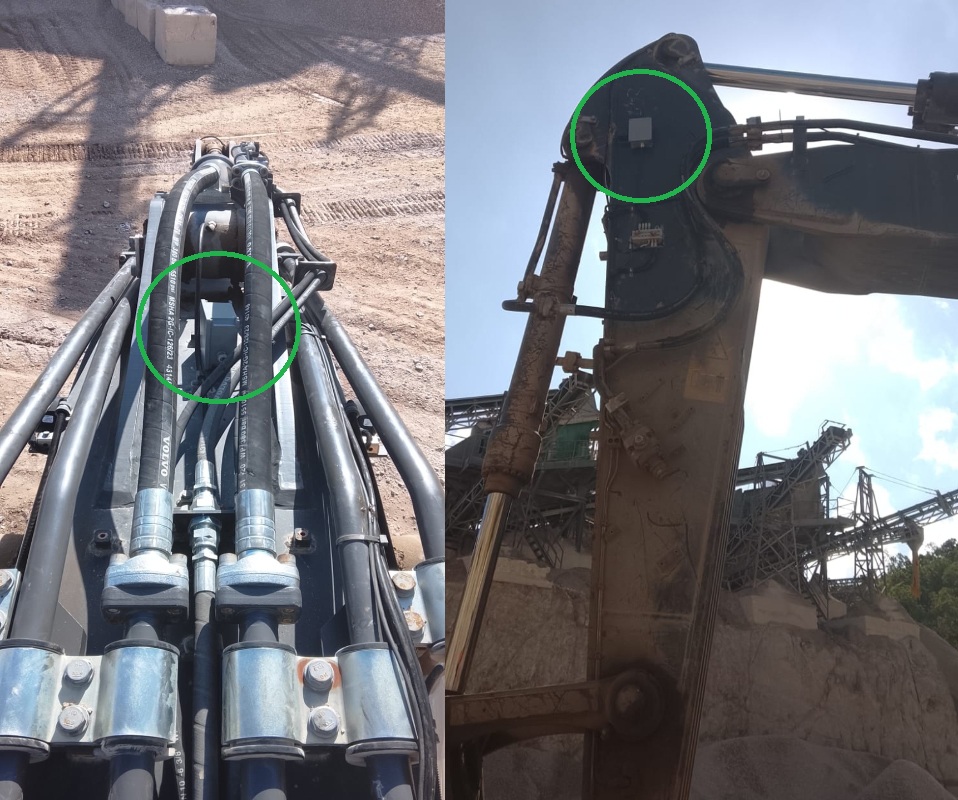
<p>The solution is based on continuous detection of the position of the main moving elements of the excavator arm. Through a proprietary geometric calculation algorithm, the system reconstructs the arm configuration in real time and determines:</p>
<ul>
<li class="">excavation depth with centimeter-level precision;</li>
<li class="">height relative to the machine reference plane;</li>
<li class="">bucket operating position;</li>
<li class="">operations history;</li>
<li class="">machine productivity.</li>
</ul>
<p>All of this without modifying the machine structure and with fast installation.</p>
<div style="text-align:center"><img src="https://docs.mative.ai/img/blog/volvo_dashboard.jpg" alt="Mative Cloud dashboard of a Volvo EC 380 excavator: current depth, arm angles, map" style="width:100%;height:auto"></div>
<h2 class="anchor anchorTargetStickyNavbar_Vzrq" id="real-time-data-and-cloud-telematics">Real-time data and cloud telematics<a href="https://docs.mative.ai/blog/2026/04/24/2026/excavation/#real-time-data-and-cloud-telematics" class="hash-link" aria-label="Direct link to Real-time data and cloud telematics" title="Direct link to Real-time data and cloud telematics" translate="no">​</a></h2>
<p>One of the most innovative aspects of the project is its digital component.</p>
<p>Information collected onboard the machine is automatically sent to the cloud platform, where it can be:</p>
<ul>
<li class="">monitored in real time;</li>
<li class="">historically archived;</li>
<li class="">displayed through intuitive dashboards;</li>
<li class="">exported into reports;</li>
<li class="">integrated with management systems or ERP;</li>
<li class="">analyzed through productivity KPIs.</li>
</ul>
<p>This enables site managers, fleet managers, and technical directors to maintain full control over operations.</p>
<h2 class="anchor anchorTargetStickyNavbar_Vzrq" id="concrete-benefits-for-companies-and-job-sites">Concrete benefits for companies and job sites<a href="https://docs.mative.ai/blog/2026/04/24/2026/excavation/#concrete-benefits-for-companies-and-job-sites" class="hash-link" aria-label="Direct link to Concrete benefits for companies and job sites" title="Direct link to Concrete benefits for companies and job sites" translate="no">​</a></h2>
<h3 class="anchor anchorTargetStickyNavbar_Vzrq" id="1-greater-operational-precision">1. Greater operational precision<a href="https://docs.mative.ai/blog/2026/04/24/2026/excavation/#1-greater-operational-precision" class="hash-link" aria-label="Direct link to 1. Greater operational precision" title="Direct link to 1. Greater operational precision" translate="no">​</a></h3>
<p>The operator immediately knows the depth reached, reducing errors and rework.</p>
<h3 class="anchor anchorTargetStickyNavbar_Vzrq" id="2-reduced-downtime">2. Reduced downtime<a href="https://docs.mative.ai/blog/2026/04/24/2026/excavation/#2-reduced-downtime" class="hash-link" aria-label="Direct link to 2. Reduced downtime" title="Direct link to 2. Reduced downtime" translate="no">​</a></h3>
<p>Fewer manual checks and fewer machine stoppages.</p>
<h3 class="anchor anchorTargetStickyNavbar_Vzrq" id="3-improved-safety">3. Improved safety<a href="https://docs.mative.ai/blog/2026/04/24/2026/excavation/#3-improved-safety" class="hash-link" aria-label="Direct link to 3. Improved safety" title="Direct link to 3. Improved safety" translate="no">​</a></h3>
<p>Reduced need for personnel on the ground for depth verification.</p>
<h3 class="anchor anchorTargetStickyNavbar_Vzrq" id="4-construction-site-digitalization">4. Construction site digitalization<a href="https://docs.mative.ai/blog/2026/04/24/2026/excavation/#4-construction-site-digitalization" class="hash-link" aria-label="Direct link to 4. Construction site digitalization" title="Direct link to 4. Construction site digitalization" translate="no">​</a></h3>
<p>Excavation becomes a traceable and measurable process.</p>
<h3 class="anchor anchorTargetStickyNavbar_Vzrq" id="5-maintenance-and-advanced-analytics">5. Maintenance and advanced analytics<a href="https://docs.mative.ai/blog/2026/04/24/2026/excavation/#5-maintenance-and-advanced-analytics" class="hash-link" aria-label="Direct link to 5. Maintenance and advanced analytics" title="Direct link to 5. Maintenance and advanced analytics" translate="no">​</a></h3>
<p>Data can be used to evaluate machine usage, work cycles, and predictive maintenance.</p>
<h2 class="anchor anchorTargetStickyNavbar_Vzrq" id="a-scalable-solution">A scalable solution<a href="https://docs.mative.ai/blog/2026/04/24/2026/excavation/#a-scalable-solution" class="hash-link" aria-label="Direct link to A scalable solution" title="Direct link to A scalable solution" translate="no">​</a></h2>
<p>The system is designed to be adopted on different types of earthmoving machines and can evolve with future features such as:</p>
<ul>
<li class="">3D excavation maps;</li>
<li class="">volumetric calculation of moved material;</li>
<li class="">georeferencing of works;</li>
<li class="">integration with BIM and digital construction models;</li>
<li class="">artificial intelligence for optimization of operating cycles.</li>
</ul>
<h2 class="anchor anchorTargetStickyNavbar_Vzrq" id="the-future-of-excavators-is-connected">The future of excavators is connected<a href="https://docs.mative.ai/blog/2026/04/24/2026/excavation/#the-future-of-excavators-is-connected" class="hash-link" aria-label="Direct link to The future of excavators is connected" title="Direct link to The future of excavators is connected" translate="no">​</a></h2>
<p>The construction sector is undergoing a profound digital transformation. Machines are no longer just mechanical equipment, but intelligent nodes in a data network capable of generating value.</p>
<p>With this project, we aim to bring to market a concrete, accessible, and immediately useful technology: <strong>a tool capable of improving profitability, control, and precision in every excavation project</strong>.</p>
<h2 class="anchor anchorTargetStickyNavbar_Vzrq" id="want-to-test-it-on-your-fleet">Want to test it on your fleet?<a href="https://docs.mative.ai/blog/2026/04/24/2026/excavation/#want-to-test-it-on-your-fleet" class="hash-link" aria-label="Direct link to Want to test it on your fleet?" title="Direct link to Want to test it on your fleet?" translate="no">​</a></h2>
<p>We are launching pilot programs and collaborations with contractors, rental companies, and operators in the earthmoving sector.</p>
<p>📩 <a href="https://www.mative.ai/en/contact" target="_blank" rel="noopener noreferrer" class="">Contact us</a> for a demo or to evaluate integration on your fleet.</p>
<h2 class="anchor anchorTargetStickyNavbar_Vzrq" id="learn-more">Learn more<a href="https://docs.mative.ai/blog/2026/04/24/2026/excavation/#learn-more" class="hash-link" aria-label="Direct link to Learn more" title="Direct link to Learn more" translate="no">​</a></h2>
<ul>
<li class=""><a class="" href="https://docs.mative.ai/blog/2026/04/24/2026/weight-measurement/">Mative’s solution for on-board load weight measurement</a></li>
<li class=""><a class="" href="https://docs.mative.ai/blog/2024/08/01/2024/report-construction-company/">IoT &amp; ML: Energy and economic benefits in a Construction Company</a></li>
<li class=""><a class="" href="https://docs.mative.ai/blog/2024/08/31/2024/guide-to-industry-bonus/">Guide to Industry 4.0 Bonuses</a></li>
<li class=""><a class="" href="https://docs.mative.ai/docs/Technology/Mative%20Cloud/mative_cloud/">What is Mative Cloud</a></li>
<li class=""><a href="https://www.mative.ai/en/industries/construction-heavy-equipment" target="_blank" rel="noopener noreferrer" class="">Mative solutions for construction and heavy equipment</a></li>
</ul>]]></content>
        <author>
            <name>Gianmaria Meriano</name>
            <uri>https://www.linkedin.com/in/gianmaria-meriano/</uri>
        </author>
        <category label="construction" term="construction"/>
        <category label="telemetry" term="telemetry"/>
        <category label="iot" term="iot"/>
        <category label="industry_40" term="industry_40"/>
    </entry>
    <entry>
        <title type="html"><![CDATA[Open Charge Point Protocol (OCPP): comprehensive overview]]></title>
        <id>https://docs.mative.ai/blog/2026/02/01/2026/occp/</id>
        <link href="https://docs.mative.ai/blog/2026/02/01/2026/occp/"/>
        <updated>2026-02-01T00:00:00.000Z</updated>
        <summary type="html"><![CDATA[What the Open Charge Point Protocol is and how chargers talk to a management system: architecture, OCPI and ISO 15118, OCPP 1.6 and 2.0.1, smart charging and the road to smart grids.]]></summary>
        <content type="html"><![CDATA[<div style="text-align:center"><img src="https://docs.mative.ai/img/blog/charging-station1.jpg" alt="Electric car plugged into a public charging station on a city street" style="width:100%;height:auto"></div>
<h2 class="anchor anchorTargetStickyNavbar_Vzrq" id="introduction">Introduction<a href="https://docs.mative.ai/blog/2026/02/01/2026/occp/#introduction" class="hash-link" aria-label="Direct link to Introduction" title="Direct link to Introduction" translate="no">​</a></h2>
<p>Electric mobility is expanding at an unprecedented pace. According to the International Energy Agency, by 2030 over 300 million electric vehicles will be in circulation worldwide. This growth demands charging infrastructure that is capillary, reliable — and above all, interoperable.</p>
<p>This is where the <strong>Open Charge Point Protocol (OCPP)</strong> plays a decisive role: it is the common language that enables charging stations, distribution networks, and management systems to communicate regardless of manufacturer. At Mative, we integrate and manage OCPP within our IoT platform, enabling intelligent monitoring, control, and analytics for EV charging infrastructure.</p>
<hr>
<h2 class="anchor anchorTargetStickyNavbar_Vzrq" id="origins-and-historical-context">Origins and Historical Context<a href="https://docs.mative.ai/blog/2026/02/01/2026/occp/#origins-and-historical-context" class="hash-link" aria-label="Direct link to Origins and Historical Context" title="Direct link to Origins and Historical Context" translate="no">​</a></h2>
<p>Before OCPP, the EV charging market was fragmented into a patchwork of <strong>proprietary, closed ecosystems</strong>. Each charging station manufacturer used its own communication protocols, making centralized management of mixed-brand stations virtually impossible. An operator managing a heterogeneous network was forced to run multiple parallel software systems, driving up operational costs and delivering an inconsistent user experience.</p>
<p>In <strong>2009</strong>, the <strong>Open Charge Alliance (OCA)</strong> — an international consortium of operators, manufacturers, and service providers in the EV sector — responded to this fragmentation by introducing OCPP as an open standard. The goal was clear: standardize communication between charging stations and Central System Management Systems (CSMS), breaking down barriers between heterogeneous technologies and fostering a truly competitive market.</p>
<p>The initiative proved remarkably successful: OCPP is now the de facto standard in European and North American markets, adopted by hundreds of manufacturers and thousands of network operators.</p>
<hr>
<h2 class="anchor anchorTargetStickyNavbar_Vzrq" id="how-ocpp-works-the-core-architecture">How OCPP Works: The Core Architecture<a href="https://docs.mative.ai/blog/2026/02/01/2026/occp/#how-ocpp-works-the-core-architecture" class="hash-link" aria-label="Direct link to How OCPP Works: The Core Architecture" title="Direct link to How OCPP Works: The Core Architecture" translate="no">​</a></h2>
<p>OCPP governs communication between two main actors:</p>
<ul>
<li class=""><strong>The Charging Station (CS)</strong> — the physical unit installed in the field.</li>
<li class=""><strong>The Central System (CSMS)</strong> — the software platform that remotely manages, monitors, and controls the stations.</li>
</ul>
<p>Communication happens over <strong>WebSocket</strong> (in more recent versions) and is based on an <strong>asynchronous request/response model</strong>: each message is uniquely identified, which reduces the impact of latency and ensures reliability even over unstable connections. The protocol natively supports <strong>temporary disconnection scenarios</strong>, with automatic retry mechanisms, local transaction buffering, and timestamp-based synchronization.</p>
<p>This architectural robustness makes OCPP well-suited for geographically distributed deployments — highways, industrial areas, rural zones — where connectivity cannot always be guaranteed.</p>
<hr>
<h2 class="anchor anchorTargetStickyNavbar_Vzrq" id="the-complementary-protocol-ecosystem">The Complementary Protocol Ecosystem<a href="https://docs.mative.ai/blog/2026/02/01/2026/occp/#the-complementary-protocol-ecosystem" class="hash-link" aria-label="Direct link to The Complementary Protocol Ecosystem" title="Direct link to The Complementary Protocol Ecosystem" translate="no">​</a></h2>
<p>OCPP does not operate in isolation. It is part of a broader ecosystem of standards that together cover the entire lifecycle of electric charging.</p>
<h3 class="anchor anchorTargetStickyNavbar_Vzrq" id="ocpi--open-charge-point-interface">OCPI — Open Charge Point Interface<a href="https://docs.mative.ai/blog/2026/02/01/2026/occp/#ocpi--open-charge-point-interface" class="hash-link" aria-label="Direct link to OCPI — Open Charge Point Interface" title="Direct link to OCPI — Open Charge Point Interface" translate="no">​</a></h3>
<p>While OCPP handles <strong>vertical</strong> communication between the charging station and the central system, <strong>OCPI</strong> manages <strong>horizontal</strong> communication between Charge Point Operators (CPOs) and e-Mobility Service Providers (eMSPs). It enables <strong>roaming</strong> between different networks: a user can charge on any compatible network using a single account or RFID card — much like international roaming on mobile networks.</p>
<h3 class="anchor anchorTargetStickyNavbar_Vzrq" id="iso-15118--vehicle-to-infrastructure-communication">ISO 15118 — Vehicle-to-Infrastructure Communication<a href="https://docs.mative.ai/blog/2026/02/01/2026/occp/#iso-15118--vehicle-to-infrastructure-communication" class="hash-link" aria-label="Direct link to ISO 15118 — Vehicle-to-Infrastructure Communication" title="Direct link to ISO 15118 — Vehicle-to-Infrastructure Communication" translate="no">​</a></h3>
<p>ISO 15118 defines the direct communication protocol between the <strong>vehicle</strong> and the <strong>charging station</strong>, without intermediaries. It enables two strategically important features:</p>
<ul>
<li class=""><strong>Plug &amp; Charge</strong>: the vehicle automatically authenticates to the network as soon as the cable is inserted, eliminating the need for apps, RFID cards, or PIN codes.</li>
<li class=""><strong>Vehicle-to-Grid (V2G)</strong>: the vehicle becomes an active participant in the power grid, capable of feeding energy back into the network during peak demand. This transforms the electric car from a simple consumer into a true distributed energy resource.</li>
</ul>
<h3 class="anchor anchorTargetStickyNavbar_Vzrq" id="openadr--demand-response-management">OpenADR — Demand Response Management<a href="https://docs.mative.ai/blog/2026/02/01/2026/occp/#openadr--demand-response-management" class="hash-link" aria-label="Direct link to OpenADR — Demand Response Management" title="Direct link to OpenADR — Demand Response Management" translate="no">​</a></h3>
<p><strong>OpenADR</strong> (Open Automated Demand Response) operates at the electricity distribution network level. It allows grid operators to send automatic signals to charging stations to modulate consumption in real time — for example, reducing delivered power during demand peaks or taking advantage of surplus renewable energy. The integration of OCPP with OpenADR is a cornerstone for next-generation <strong>smart grid</strong> development.</p>
<hr>
<h2 class="anchor anchorTargetStickyNavbar_Vzrq" id="core-features-of-ocpp">Core Features of OCPP<a href="https://docs.mative.ai/blog/2026/02/01/2026/occp/#core-features-of-ocpp" class="hash-link" aria-label="Direct link to Core Features of OCPP" title="Direct link to Core Features of OCPP" translate="no">​</a></h2>
<h3 class="anchor anchorTargetStickyNavbar_Vzrq" id="interoperability">Interoperability<a href="https://docs.mative.ai/blog/2026/02/01/2026/occp/#interoperability" class="hash-link" aria-label="Direct link to Interoperability" title="Direct link to Interoperability" translate="no">​</a></h3>
<p>OCPP frees operators from dependence on a single vendor. A charging station from any certified manufacturer can communicate with any compatible CSMS. This dramatically reduces <strong>technological lock-in risk</strong> and fosters market competition, with direct benefits on deployment and maintenance costs.</p>
<h3 class="anchor anchorTargetStickyNavbar_Vzrq" id="scalability">Scalability<a href="https://docs.mative.ai/blog/2026/02/01/2026/occp/#scalability" class="hash-link" aria-label="Direct link to Scalability" title="Direct link to Scalability" translate="no">​</a></h3>
<p>The protocol was designed to support charging networks of any size — from a small private parking lot to national networks with thousands of distributed points. The asynchronous architecture ensures stable performance even with a large number of stations connected simultaneously.</p>
<h3 class="anchor anchorTargetStickyNavbar_Vzrq" id="security">Security<a href="https://docs.mative.ai/blog/2026/02/01/2026/occp/#security" class="hash-link" aria-label="Direct link to Security" title="Direct link to Security" translate="no">​</a></h3>
<p>OCPP includes robust security mechanisms: data encryption via <strong>TLS</strong> (Transport Layer Security), mutual client-server authentication, and — in version 2.0.1 — a multi-layered security model with granular management of digital certificates. In a sector where charging stations are critical infrastructure, cybersecurity is not optional.</p>
<h3 class="anchor anchorTargetStickyNavbar_Vzrq" id="smart-charging">Smart Charging<a href="https://docs.mative.ai/blog/2026/02/01/2026/occp/#smart-charging" class="hash-link" aria-label="Direct link to Smart Charging" title="Direct link to Smart Charging" translate="no">​</a></h3>
<p>One of the most operationally relevant features: OCPP enables <strong>intelligent charging</strong>, dynamically adjusting the power delivered by each station based on local grid availability, real-time energy costs, and operator-defined priorities. In a context of growing renewable energy penetration — with its inherent variability — this modulation capability is essential to prevent grid congestion.</p>
<h3 class="anchor anchorTargetStickyNavbar_Vzrq" id="offline-management">Offline Management<a href="https://docs.mative.ai/blog/2026/02/01/2026/occp/#offline-management" class="hash-link" aria-label="Direct link to Offline Management" title="Direct link to Offline Management" translate="no">​</a></h3>
<p>OCPP ensures operational continuity even when the connection to the central system is lost. Transactions are buffered locally and synchronized once connectivity is restored. This is particularly relevant for stations installed in areas with limited network coverage.</p>
<hr>
<h2 class="anchor anchorTargetStickyNavbar_Vzrq" id="protocol-versions">Protocol Versions<a href="https://docs.mative.ai/blog/2026/02/01/2026/occp/#protocol-versions" class="hash-link" aria-label="Direct link to Protocol Versions" title="Direct link to Protocol Versions" translate="no">​</a></h2>
<h3 class="anchor anchorTargetStickyNavbar_Vzrq" id="ocpp-16">OCPP 1.6<a href="https://docs.mative.ai/blog/2026/02/01/2026/occp/#ocpp-16" class="hash-link" aria-label="Direct link to OCPP 1.6" title="Direct link to OCPP 1.6" translate="no">​</a></h3>
<p>Currently the most widely deployed version in the market. Compared to earlier releases, it introduced native support for <strong>JSON</strong> format (in addition to the more verbose SOAP/XML), reducing communication overhead and simplifying integration with modern technology stacks. It offers comprehensive functional coverage for the vast majority of operational scenarios and is characterized by high stability, the result of years of real-world deployment.</p>
<h3 class="anchor anchorTargetStickyNavbar_Vzrq" id="ocpp-201">OCPP 2.0.1<a href="https://docs.mative.ai/blog/2026/02/01/2026/occp/#ocpp-201" class="hash-link" aria-label="Direct link to OCPP 2.0.1" title="Direct link to OCPP 2.0.1" translate="no">​</a></h3>
<p>The latest version represents a significant evolutionary leap. Key innovations include:</p>
<ul>
<li class=""><strong>Advanced security</strong>: a layered security model with X.509 digital certificate support and centralized credential management.</li>
<li class=""><strong>Enhanced smart charging</strong>: support for more granular charging profiles and dynamic tariff models, with real-time negotiation of available power.</li>
<li class=""><strong>Component-based architecture</strong>: the charging station is modeled as a set of independent logical components (EVSE, connectors, etc.), offering greater flexibility in remote configuration.</li>
<li class=""><strong>Deeper ISO 15118 integration</strong>: essential for enabling Plug &amp; Charge and V2G at scale.</li>
</ul>
<p>The main barrier to widespread OCPP 2.0.1 adoption is its <strong>lack of backward compatibility</strong> with version 1.6, which requires significant hardware and software upgrades to existing infrastructure. Adoption is growing but will take time to become dominant.</p>
<hr>
<h2 class="anchor anchorTargetStickyNavbar_Vzrq" id="strategic-role-in-the-ev-market-and-iot-integration">Strategic Role in the EV Market and IoT Integration<a href="https://docs.mative.ai/blog/2026/02/01/2026/occp/#strategic-role-in-the-ev-market-and-iot-integration" class="hash-link" aria-label="Direct link to Strategic Role in the EV Market and IoT Integration" title="Direct link to Strategic Role in the EV Market and IoT Integration" translate="no">​</a></h2>
<p>OCPP today is far more than a technical protocol: it is a <strong>business enabler</strong>. The standardization it introduces allows new operators to enter the market without developing proprietary technologies from scratch, lowering barriers to entry and stimulating innovation.</p>
<p>From the perspective of the <strong>Mative platform</strong>, OCPP represents a strategic gateway for collecting operational data from charging stations: connection status, energy consumption, charging sessions, anomalies, and alarms. Once acquired, this data can be processed with artificial intelligence models to optimize network management, predict failures, and maximize infrastructure availability.</p>
<p>Integration with <strong>renewable energy sources</strong> — photovoltaic, wind — and with corporate <strong>energy management systems</strong> is another high-value development area: OCPP, combined with OpenADR, makes it possible to build charging systems that maximize the use of locally produced energy, reducing both costs and environmental impact.</p>
<hr>
<h2 class="anchor anchorTargetStickyNavbar_Vzrq" id="future-evolution-toward-smart-grids">Future Evolution: Toward Smart Grids<a href="https://docs.mative.ai/blog/2026/02/01/2026/occp/#future-evolution-toward-smart-grids" class="hash-link" aria-label="Direct link to Future Evolution: Toward Smart Grids" title="Direct link to Future Evolution: Toward Smart Grids" translate="no">​</a></h2>
<p>OCPP's evolution over the coming years will be driven by three converging trends:</p>
<p><strong>Widespread Plug &amp; Charge adoption.</strong> As ISO 15118 is deployed at scale, RFID and app-based authentication will become obsolete. Vehicles will autonomously identify themselves to the network, making the charging experience as frictionless as traditional refueling — no apps, no cards, no friction.</p>
<p><strong>Vehicle-to-Grid expansion.</strong> V2G will transform fleets of electric vehicles into distributed storage systems, capable of contributing to grid stability during critical hours. OCPP, integrated with ISO 15118, is the connective tissue that makes this scenario possible.</p>
<p><strong>Integration into next-generation smart grids.</strong> In the medium term, OCPP will become a core infrastructure component of intelligent electricity networks, contributing to distributed energy management at both local and national levels. AI-powered automation, fed by data collected via IoT, will be the differentiating factor for operators able to fully leverage the protocol's potential.</p>
<hr>
<h2 class="anchor anchorTargetStickyNavbar_Vzrq" id="conclusions">Conclusions<a href="https://docs.mative.ai/blog/2026/02/01/2026/occp/#conclusions" class="hash-link" aria-label="Direct link to Conclusions" title="Direct link to Conclusions" translate="no">​</a></h2>
<p>OCPP is not simply a technical standard: it is the backbone of tomorrow's charging infrastructure. Its ability to ensure interoperability, scalability, and openness makes it indispensable for anyone operating in the electric mobility sector.</p>
<p>At Mative, we integrate OCPP as part of a broader IoT architecture, where data collected from charging stations becomes input for artificial intelligence models capable of optimizing operations, reducing costs, and improving the end-user experience. The energy transition is not won with better hardware alone: it is won with data, intelligence, and open protocols.</p>
<hr>
<p><em>Learn more about how Mative integrates OCPP and IoT in charging infrastructure: <a href="https://www.mative.ai/en/industries/ev-infrastructures" target="_blank" rel="noopener noreferrer" class="">mative.ai</a></em></p>
<h2 class="anchor anchorTargetStickyNavbar_Vzrq" id="learn-more">Learn more<a href="https://docs.mative.ai/blog/2026/02/01/2026/occp/#learn-more" class="hash-link" aria-label="Direct link to Learn more" title="Direct link to Learn more" translate="no">​</a></h2>
<ul>
<li class=""><a class="" href="https://docs.mative.ai/blog/2024/03/25/2024/electric-vehicles/">Electric Vehicles</a></li>
<li class=""><a class="" href="https://docs.mative.ai/blog/2024/03/25/2024/fuel-and-energy/">Fuel and Energy</a></li>
<li class=""><a class="" href="https://docs.mative.ai/blog/2024/03/25/2024/mqtt-advanced/">MQTT Advanced</a></li>
<li class=""><a class="" href="https://docs.mative.ai/docs/Technology/Mative%20Cloud/mative_cloud/">What is Mative Cloud</a></li>
<li class=""><a href="https://www.mative.ai/en/solutions/energy-sustainability" target="_blank" rel="noopener noreferrer" class="">Mative energy and sustainability solutions</a></li>
</ul>]]></content>
        <author>
            <name>Gianmaria Meriano</name>
            <uri>https://www.linkedin.com/in/gianmaria-meriano/</uri>
        </author>
        <category label="automotive" term="automotive"/>
        <category label="ocpp" term="ocpp"/>
        <category label="ev" term="ev"/>
        <category label="IoT" term="IoT"/>
        <category label="smart charging" term="smart charging"/>
        <category label="V2G" term="V2G"/>
    </entry>
    <entry>
        <title type="html"><![CDATA[How RFID Monitoring Works in Garbage Collection Trucks]]></title>
        <id>https://docs.mative.ai/blog/2026/01/01/2026/waste-rfid/</id>
        <link href="https://docs.mative.ai/blog/2026/01/01/2026/waste-rfid/"/>
        <updated>2026-01-01T00:00:00.000Z</updated>
        <summary type="html"><![CDATA[How RFID monitoring works on garbage collection trucks: UHF tags on bins, onboard antennas and readers, GPS and 4G data, PAYT billing and route optimization.]]></summary>
        <content type="html"><![CDATA[<div style="text-align:center"><img src="https://docs.mative.ai/img/blog/rfid-waste-cargo.png" alt="Garbage truck RFID system: antenna, reader and GPS transmitter sending bin data to back office" style="width:100%;height:auto"></div>
<h2 class="anchor anchorTargetStickyNavbar_Vzrq" id="how-rfid-monitoring-works-in-waste-collection-trucks-the-smart--eco-sustainable-revolution-by-mative">How RFID Monitoring Works in Waste Collection Trucks: The Smart &amp; Eco-Sustainable Revolution by Mative<a href="https://docs.mative.ai/blog/2026/01/01/2026/waste-rfid/#how-rfid-monitoring-works-in-waste-collection-trucks-the-smart--eco-sustainable-revolution-by-mative" class="hash-link" aria-label="Direct link to How RFID Monitoring Works in Waste Collection Trucks: The Smart &amp; Eco-Sustainable Revolution by Mative" title="Direct link to How RFID Monitoring Works in Waste Collection Trucks: The Smart &amp; Eco-Sustainable Revolution by Mative" translate="no">​</a></h2>
<h2 class="anchor anchorTargetStickyNavbar_Vzrq" id="introduction">Introduction<a href="https://docs.mative.ai/blog/2026/01/01/2026/waste-rfid/#introduction" class="hash-link" aria-label="Direct link to Introduction" title="Direct link to Introduction" translate="no">​</a></h2>
<p>In the framework of modern Smart City management, <strong>IoT (Internet of Things)</strong> and <strong>RFID (Radio Frequency Identification)</strong> technologies represent some of the most effective and revolutionary tools available to optimize waste collection processes, maximize traceability, and elevate urban service quality.</p>
<p><strong>Mative</strong> has engineered a comprehensive, state-of-the-art ecosystem for integrating and managing advanced waste tracking workflows. By deploying custom, heavy-duty RFID hardware directly onto collection trucks, municipalities and waste management utilities can automatically identify containers, categorize collected waste streams, and stream data in real-time to the back-office. This eliminates human error and digitizes the entire environmental supply chain. Below, we break down the architecture, operational workflow, and strategic advantages of this technology.</p>
<hr>
<h2 class="anchor anchorTargetStickyNavbar_Vzrq" id="system-architecture-the-hardware-and-software-infrastructure">System Architecture: The Hardware and Software Infrastructure<a href="https://docs.mative.ai/blog/2026/01/01/2026/waste-rfid/#system-architecture-the-hardware-and-software-infrastructure" class="hash-link" aria-label="Direct link to System Architecture: The Hardware and Software Infrastructure" title="Direct link to System Architecture: The Hardware and Software Infrastructure" translate="no">​</a></h2>
<p>An enterprise-grade RFID waste collection system relies on the seamless synergy between four primary hardware components, orchestrated by <strong>Mative’s</strong> central cloud software. This modular, highly scalable architecture manages the entire lifecycle of data:</p>
<h3 class="anchor anchorTargetStickyNavbar_Vzrq" id="1-passive-uhf-rfid-tags-on-waste-containers">1. Passive UHF RFID Tags on Waste Containers<a href="https://docs.mative.ai/blog/2026/01/01/2026/waste-rfid/#1-passive-uhf-rfid-tags-on-waste-containers" class="hash-link" aria-label="Direct link to 1. Passive UHF RFID Tags on Waste Containers" title="Direct link to 1. Passive UHF RFID Tags on Waste Containers" translate="no">​</a></h3>
<p>Every bin, dumpster, or residential tote is outfitted with an <strong>ultra-rugged Ultra-High Frequency (UHF) passive RFID tag</strong>. These specialized transponders are built to survive extreme weather conditions, high-pressure washing, and intense mechanical stress. Each tag holds:</p>
<ul>
<li class=""><strong>Global Unique Identifier (UID):</strong> A non-duplicable, factory-locked serial number.</li>
<li class=""><strong>Account Association:</strong> A direct link in the central database to a specific household, commercial user, or geographic zone.</li>
<li class=""><strong>Waste Type Setting:</strong> Pre-configured classification of the material stream (e.g., residual waste, organic, paper, glass/plastic).</li>
</ul>
<p>Because these tags are <strong>passive</strong>, they do not require internal batteries. Instead, they are temporarily powered by the electromagnetic field generated by the truck’s antenna during the tilt cycle, ensuring a virtually maintenance-free lifespan of over 10 years.</p>
<h3 class="anchor anchorTargetStickyNavbar_Vzrq" id="2-long-range-rugged-rfid-antennas-on-the-vehicle">2. Long-Range Rugged RFID Antennas on the Vehicle<a href="https://docs.mative.ai/blog/2026/01/01/2026/waste-rfid/#2-long-range-rugged-rfid-antennas-on-the-vehicle" class="hash-link" aria-label="Direct link to 2. Long-Range Rugged RFID Antennas on the Vehicle" title="Direct link to 2. Long-Range Rugged RFID Antennas on the Vehicle" translate="no">​</a></h3>
<p>Collection vehicles are equipped with directional RFID antennas featuring high ingress protection ratings (IP67/IP69K). These antennas are strategically positioned near the mechanical lifting mechanism (rear-loaders, side-loaders, or front-loaders).</p>
<p>Their primary function is twofold:</p>
<ul>
<li class=""><strong>Electromagnetic Field Generation:</strong> Activating the passive tag the moment the bin enters the designated reading zone.</li>
<li class=""><strong>Contactless Reading Accuracy:</strong> Capturing data within milliseconds, even in high-vibration environments, high operational speeds, or when covered in dirt and grime.</li>
</ul>
<h3 class="anchor anchorTargetStickyNavbar_Vzrq" id="3-industrial-rfid-reader-and-onboard-computer-unit">3. Industrial RFID Reader and Onboard Computer Unit<a href="https://docs.mative.ai/blog/2026/01/01/2026/waste-rfid/#3-industrial-rfid-reader-and-onboard-computer-unit" class="hash-link" aria-label="Direct link to 3. Industrial RFID Reader and Onboard Computer Unit" title="Direct link to 3. Industrial RFID Reader and Onboard Computer Unit" translate="no">​</a></h3>
<p>The antenna connects directly to the computational heart of the truck: an <strong>industrial RFID Reader</strong> paired with a ruggedized <strong>Onboard Computer</strong> running a real-time operating system.</p>
<p>This module executes several critical edge computing functions:</p>
<ul>
<li class=""><strong>False-Positive Filtering:</strong> Advanced algorithms prevent cross-reading adjacent bins left on the sidewalk that are not being serviced.</li>
<li class=""><strong>Edge Validation &amp; Sensor Fusion:</strong> The system validates the collection event by cross-referencing the RFID read with mechanical telemetry (such as hydraulic pressure or arm inclination sensors). This certifies that the bin was actually emptied, rather than just driven past.</li>
</ul>
<h3 class="anchor anchorTargetStickyNavbar_Vzrq" id="4-high-precision-gps-and-cellular-communication-modules">4. High-Precision GPS and Cellular Communication Modules<a href="https://docs.mative.ai/blog/2026/01/01/2026/waste-rfid/#4-high-precision-gps-and-cellular-communication-modules" class="hash-link" aria-label="Direct link to 4. High-Precision GPS and Cellular Communication Modules" title="Direct link to 4. High-Precision GPS and Cellular Communication Modules" translate="no">​</a></h3>
<p>The onboard telematics unit integrates robust global connectivity:</p>
<ul>
<li class=""><strong>High-Precision GPS/GNSS Receiver:</strong> Records the exact geographic coordinates (latitude and longitude) down to the millisecond of the collection event.</li>
<li class=""><strong>4G/5G/LTE Communication Module (with Satellite Failover):</strong> Establishes an encrypted, secure channel to transmit telemetry packets directly to Mative's cloud servers. In cellular dead zones (e.g., rural areas or mountainous terrain), the system stores the data locally in secure flash memory and auto-syncs as soon as connectivity is restored.</li>
</ul>
<hr>
<h2 class="anchor anchorTargetStickyNavbar_Vzrq" id="real-time-operational-workflow-from-street-to-cloud">Real-Time Operational Workflow: From Street to Cloud<a href="https://docs.mative.ai/blog/2026/01/01/2026/waste-rfid/#real-time-operational-workflow-from-street-to-cloud" class="hash-link" aria-label="Direct link to Real-Time Operational Workflow: From Street to Cloud" title="Direct link to Real-Time Operational Workflow: From Street to Cloud" translate="no">​</a></h2>
<p>The tracking process is entirely automated, requiring zero manual inputs or extra steps from the collection crew:</p>
<div class="language-text codeBlockContainer_Ckt0 theme-code-block" style="--prism-color:#F8F8F2;--prism-background-color:#282A36"><div class="codeBlockContent_QJqH"><pre tabindex="0" class="prism-code language-text codeBlock_bY9V thin-scrollbar" style="color:#F8F8F2;background-color:#282A36"><code class="codeBlockLines_e6Vv"><div class="token-line" style="color:#F8F8F2"><span class="token plain">[ Vehicle Approaches Container ] </span><br></div><div class="token-line" style="color:#F8F8F2"><span class="token plain">               │</span><br></div><div class="token-line" style="color:#F8F8F2"><span class="token plain">               ▼</span><br></div><div class="token-line" style="color:#F8F8F2"><span class="token plain">[ Mechanical Lifter Engages Bin ] ──► (Arm Telemetry Sensor Triggers)</span><br></div><div class="token-line" style="color:#F8F8F2"><span class="token plain">               │</span><br></div><div class="token-line" style="color:#F8F8F2"><span class="token plain">               ▼</span><br></div><div class="token-line" style="color:#F8F8F2"><span class="token plain">[ Antenna Field Activates ] ──► (Powers Passive RFID Tag)</span><br></div><div class="token-line" style="color:#F8F8F2"><span class="token plain">               │</span><br></div><div class="token-line" style="color:#F8F8F2"><span class="token plain">               ▼</span><br></div><div class="token-line" style="color:#F8F8F2"><span class="token plain">[ Instant UID Capture &amp; Edge Validation ]</span><br></div><div class="token-line" style="color:#F8F8F2"><span class="token plain">               │</span><br></div><div class="token-line" style="color:#F8F8F2"><span class="token plain">               ▼</span><br></div><div class="token-line" style="color:#F8F8F2"><span class="token plain">[ Data Enrichment ] ──► (Injects: Exact Timestamp + GPS Coordinates + Weight if applicable)</span><br></div><div class="token-line" style="color:#F8F8F2"><span class="token plain">               │</span><br></div><div class="token-line" style="color:#F8F8F2"><span class="token plain">               ▼</span><br></div><div class="token-line" style="color:#F8F8F2"><span class="token plain">[ Encrypted Transmission via 4G/5G Telemetry ]</span><br></div><div class="token-line" style="color:#F8F8F2"><span class="token plain">               │</span><br></div><div class="token-line" style="color:#F8F8F2"><span class="token plain">               ▼</span><br></div><div class="token-line" style="color:#F8F8F2"><span class="token plain">[ Cloud Ingestion &amp; Real-Time Back-Office Dashboard Update ]</span><br></div></code></pre></div></div>
<ol>
<li class=""><strong>Approach and Engagement:</strong> The truck aligns with the container, and the mechanical lift grabs the bin.</li>
<li class=""><strong>Reading Trigger:</strong> Lifting sensors detect the mechanical motion and instantly power up the RFID antenna's reading field.</li>
<li class=""><strong>Capture and Edge Processing:</strong> The antenna captures the tag's UID. The onboard software processes the signal and generates a secure ledger packet known as a "Collection Event."</li>
<li class=""><strong>Data Enrichment:</strong> The system injects real-time parameters: <em>exact timestamp, sub-meter GPS coordinates, vehicle ID, and any driver-reported operational codes</em> (entered via the in-cabin touchscreen).</li>
<li class=""><strong>Cloud Synchronization:</strong> The complete data package is dispatched over the cellular network and logged into the central database instantaneously.</li>
</ol>
<hr>
<h2 class="anchor anchorTargetStickyNavbar_Vzrq" id="back-office-platform-and-business-intelligence">Back-Office Platform and Business Intelligence<a href="https://docs.mative.ai/blog/2026/01/01/2026/waste-rfid/#back-office-platform-and-business-intelligence" class="hash-link" aria-label="Direct link to Back-Office Platform and Business Intelligence" title="Direct link to Back-Office Platform and Business Intelligence" translate="no">​</a></h2>
<p>Once telemetry flows into <strong>Mative's</strong> central platform, the back-office web application (accessible via browser or REST APIs) turns raw data into actionable business intelligence for utility operators and city officials:</p>
<ul>
<li class=""><strong>Pay-As-You-Throw (PAYT) Support:</strong> This is the primary regulatory and economic driver. By knowing precisely how many times a specific user has discharged their residual (non-recyclable) waste, utilities can generate fair, volume-based waste bills instead of relying on generic property-tax estimates. This rewards eco-conscious citizens.</li>
<li class=""><strong>Dynamic Route Optimization (Smart Routing):</strong> By tracking historical collection patterns and container fill histories, routing algorithms simulate and deploy optimal collection paths. This prevents trucks from servicing half-empty dumpsters, cutting $CO_2$ emissions, fuel consumption, and fleet wear-and-tear.</li>
<li class=""><strong>SLA Compliance &amp; Operations Monitoring:</strong> Real-time fleet overview via interactive live maps with Geofencing. Fleet managers can evaluate route completion percentages and instantly audit operator performance against contractual service level agreements.</li>
<li class=""><strong>Anomalies and Exception Handling:</strong> Automated alerts for un-registered bins (cloned or unknown tags), damaged containers, or blocked access due to illegally parked vehicles (logged instantly by the driver).</li>
</ul>
<hr>
<h2 class="anchor anchorTargetStickyNavbar_Vzrq" id="strategic-advantages-of-the-mative-ecosystem">Strategic Advantages of the Mative Ecosystem<a href="https://docs.mative.ai/blog/2026/01/01/2026/waste-rfid/#strategic-advantages-of-the-mative-ecosystem" class="hash-link" aria-label="Direct link to Strategic Advantages of the Mative Ecosystem" title="Direct link to Strategic Advantages of the Mative Ecosystem" translate="no">​</a></h2>
<p>Implementing Mative's end-to-end framework delivers significant tangible benefits across the entire municipal ecosystem:</p>
<table><thead><tr><th style="text-align:left">Impact Area</th><th style="text-align:left">Key Benefit</th><th style="text-align:left">Technical Description</th></tr></thead><tbody><tr><td style="text-align:left"><strong>Operational Efficiency</strong></td><td style="text-align:left">Seamless Automation</td><td style="text-align:left">Zero downtime. Operators focus on safe driving and mechanical handling without manually scanning barcodes or filling out paper logs.</td></tr><tr><td style="text-align:left"><strong>Transparency &amp; Compliance</strong></td><td style="text-align:left">Data Integrity</td><td style="text-align:left">Every bin tip is absolute, geo-referenced, and timestamped. Provides an unalterable audit trail that prevents illegal dumping and gray-market waste processing.</td></tr><tr><td style="text-align:left"><strong>Financial Optimization</strong></td><td style="text-align:left">OPEX Minimization</td><td style="text-align:left">Reduces total driven miles, curtails unnecessary labor hours, and maximizes municipal revenue from high-purity recycled material streams.</td></tr><tr><td style="text-align:left"><strong>Environmental Sustainability</strong></td><td style="text-align:left">Circular Economy Drive</td><td style="text-align:left">Directly incentivizes waste separation through financial leverage (PAYT), significantly reducing landfill dependency and carbon footprints.</td></tr></tbody></table>
<hr>
<h2 class="anchor anchorTargetStickyNavbar_Vzrq" id="future-horizons-integrating-smart-city-capabilities">Future Horizons: Integrating Smart City Capabilities<a href="https://docs.mative.ai/blog/2026/01/01/2026/waste-rfid/#future-horizons-integrating-smart-city-capabilities" class="hash-link" aria-label="Direct link to Future Horizons: Integrating Smart City Capabilities" title="Direct link to Future Horizons: Integrating Smart City Capabilities" translate="no">​</a></h2>
<p>Mative's flexible, API-first architecture is natively ready to integrate with next-generation smart infrastructure:</p>
<ul>
<li class=""><strong>Predictive AI Models:</strong> Machine learning models that combine historical RFID collection trends with weather forecasts, seasonal public events, and demographic data to forecast bin fullness with high accuracy.</li>
<li class=""><strong>Edge Computer Vision:</strong> Onboard cameras backed by deep-learning models that inspect the quality of the waste stream during the dumping cycle. The system detects contamination (e.g., plastic in organic bins) in real-time and links the infraction directly to the scanned RFID tag.</li>
<li class=""><strong>Fleet Digital Twins:</strong> A real-time virtual replica of the city’s entire waste logistics ecosystem, allowing planners to simulate route variations and policy updates before live deployment.</li>
</ul>
<hr>
<h2 class="anchor anchorTargetStickyNavbar_Vzrq" id="conclusion">Conclusion<a href="https://docs.mative.ai/blog/2026/01/01/2026/waste-rfid/#conclusion" class="hash-link" aria-label="Direct link to Conclusion" title="Direct link to Conclusion" translate="no">​</a></h2>
<p>RFID and IoT monitoring in waste management is no longer a futuristic concept—it is an operational imperative for modern, eco-conscious municipalities. <strong>Mative’s</strong> unified ecosystem demonstrates how combining heavy-duty hardware, intelligent edge computers, and cloud-based analytics transforms traditional municipal workflows into an industrial-grade, data-driven utility. Adopting this framework empowers organizations to minimize operating costs while accelerating progress toward global circular economy goals and climate neutrality.</p>
<h2 class="anchor anchorTargetStickyNavbar_Vzrq" id="learn-more">Learn more<a href="https://docs.mative.ai/blog/2026/01/01/2026/waste-rfid/#learn-more" class="hash-link" aria-label="Direct link to Learn more" title="Direct link to Learn more" translate="no">​</a></h2>
<ul>
<li class=""><a class="" href="https://docs.mative.ai/blog/2024/03/25/2024/ml-routes-optimization/">Routes optimizations</a></li>
<li class=""><a class="" href="https://docs.mative.ai/blog/2024/08/06/2024/smart-city-traffic-turbines/">Smart City: turning traffic into clean energy</a></li>
<li class=""><a class="" href="https://docs.mative.ai/blog/2026/04/24/2026/weight-measurement/">Mative’s solution for on-board load weight measurement</a></li>
<li class=""><a class="" href="https://docs.mative.ai/docs/Technology/Mative%20Cloud/Fleet%20Management/fleet_management_intro/">What is Mative Cloud Fleet Management</a></li>
<li class=""><a href="https://www.mative.ai/en/industries/waste-recycling" target="_blank" rel="noopener noreferrer" class="">Mative solutions for waste and recycling</a></li>
</ul>]]></content>
        <author>
            <name>Gianmaria Meriano</name>
            <uri>https://www.linkedin.com/in/gianmaria-meriano/</uri>
        </author>
        <category label="rfid" term="rfid"/>
        <category label="iot" term="iot"/>
        <category label="smart_city" term="smart_city"/>
        <category label="waste_management" term="waste_management"/>
        <category label="asset_tracking" term="asset_tracking"/>
        <category label="green_tech" term="green_tech"/>
        <category label="telemetry" term="telemetry"/>
        <category label="edge_computing" term="edge_computing"/>
        <category label="logistics" term="logistics"/>
    </entry>
    <entry>
        <title type="html"><![CDATA[Incentives in Italy from September 2025]]></title>
        <id>https://docs.mative.ai/blog/2025/08/04/2025/september-italy-concessions/</id>
        <link href="https://docs.mative.ai/blog/2025/08/04/2025/september-italy-concessions/"/>
        <updated>2025-08-04T00:00:00.000Z</updated>
        <summary type="html"><![CDATA[Italian incentives for September 2025: the LogIN Business call for logistics digitalization and the twin transition voucher for SMEs in Avellino and Benevento.]]></summary>
        <content type="html"><![CDATA[<div style="text-align:center"><img src="https://docs.mative.ai/img/blog/finanziamenti-agevolati.jpg" alt="Euro banknotes and coins representing grants and incentives for businesses" style="width:100%;height:auto"></div>
<p>Noticeboard of Calls, Vouchers, and State Incentives through which Mative technologies and services can be financed:</p>
<h2 class="anchor anchorTargetStickyNavbar_Vzrq" id="login-business-call">logIN Business CALL<a href="https://docs.mative.ai/blog/2025/08/04/2025/september-italy-concessions/#login-business-call" class="hash-link" aria-label="Direct link to logIN Business CALL" title="Direct link to logIN Business CALL" translate="no">​</a></h2>
<p><em>From 1 to 15 September 2025</em></p>
<p>The Ministry of Infrastructure and Transport has published the ‘LogINBusiness’ call, a strategic measure worth 157 million euros provided by the PNRR to support the digital transition of freight transport and logistics companies. Development of the National Logistics Platform (PLN) through the digitalization of the logistics chain – also at the European level (eFTI).</p>
<ul>
<li class="">
<h3 class="anchor anchorTargetStickyNavbar_Vzrq" id="incentive">Incentive<a href="https://docs.mative.ai/blog/2025/08/04/2025/september-italy-concessions/#incentive" class="hash-link" aria-label="Direct link to Incentive" title="Direct link to Incentive" translate="no">​</a></h3>
</li>
</ul>
<p>Co-financing: 40% non-repayable grant for sustainable multimodal projects under the “De Minimis” regime, 100% non-repayable grant.</p>
<ul>
<li class="">
<h3 class="anchor anchorTargetStickyNavbar_Vzrq" id="timeline">Timeline<a href="https://docs.mative.ai/blog/2025/08/04/2025/september-italy-concessions/#timeline" class="hash-link" aria-label="Direct link to Timeline" title="Direct link to Timeline" translate="no">​</a></h3>
</li>
</ul>
<p>Platform opening: 01/09/2025<br>
<!-- -->Application deadline: 15/09/2025<br>
<!-- -->Publication of provisional ranking: after 15 September<br>
<!-- -->Project implementation: by 30/06/2026</p>
<ul>
<li class="">
<h3 class="anchor anchorTargetStickyNavbar_Vzrq" id="eligible-expenses">Eligible Expenses<a href="https://docs.mative.ai/blog/2025/08/04/2025/september-italy-concessions/#eligible-expenses" class="hash-link" aria-label="Direct link to Eligible Expenses" title="Direct link to Eligible Expenses" translate="no">​</a></h3>
</li>
</ul>
<p>Digital platforms and tools for e-CMR and load optimization<br>
<!-- -->Systems for computerized dialogue with public authorities and loaders<br>
<!-- -->Technologies for route planning, monitoring, e-learning, and AI</p>
<ul>
<li class="">
<h3 class="anchor anchorTargetStickyNavbar_Vzrq" id="how-to-apply">How to apply<a href="https://docs.mative.ai/blog/2025/08/04/2025/september-italy-concessions/#how-to-apply" class="hash-link" aria-label="Direct link to How to apply" title="Direct link to How to apply" translate="no">​</a></h3>
</li>
</ul>
<p>Via the LogIN Business platform (through MIT and RAM)<br>
<!-- -->Applications are evaluated in chronological order until resources are exhausted</p>
<hr>
<h2 class="anchor anchorTargetStickyNavbar_Vzrq" id="voucher-for-double-digital-and-ecological-transition---year-2025">Voucher for Double Digital and Ecological Transition - Year 2025<a href="https://docs.mative.ai/blog/2025/08/04/2025/september-italy-concessions/#voucher-for-double-digital-and-ecological-transition---year-2025" class="hash-link" aria-label="Direct link to Voucher for Double Digital and Ecological Transition - Year 2025" title="Direct link to Voucher for Double Digital and Ecological Transition - Year 2025" translate="no">​</a></h2>
<p><em>From 16 to 30 September 2025</em></p>
<p>As part of the strategic initiatives promoted by Unioncamere and in line with the objectives of the <a class="" href="https://docs.mative.ai/blog/2025/02/14/2025/industry-50/">Transition 5.0 Plan</a>.<br>
The measure aims to support micro, small, and medium-sized enterprises (MSMEs) by providing non-repayable vouchers for projects that promote the adoption of innovative solutions geared towards digital and/or ecological transition. Funded interventions include the purchase of capital goods, specialist consulting services, and enabling 4.0 technologies.</p>
<ul>
<li class="">
<h3 class="anchor anchorTargetStickyNavbar_Vzrq" id="financial-allocation-and-expected-contribution">Financial allocation and expected contribution<a href="https://docs.mative.ai/blog/2025/08/04/2025/september-italy-concessions/#financial-allocation-and-expected-contribution" class="hash-link" aria-label="Direct link to Financial allocation and expected contribution" title="Direct link to Financial allocation and expected contribution" translate="no">​</a></h3>
<ul>
<li class="">Fund allocated: €150,000.00</li>
<li class="">Maximum contribution per company: €5,000.00</li>
<li class="">Contribution rate: 70% of eligible expenses</li>
<li class="">Bonus: +10% for companies that have completed the PIDNEXT program</li>
</ul>
</li>
<li class="">
<h3 class="anchor anchorTargetStickyNavbar_Vzrq" id="areas-of-intervention-and-eligible-expenses">Areas of intervention and eligible expenses<a href="https://docs.mative.ai/blog/2025/08/04/2025/september-italy-concessions/#areas-of-intervention-and-eligible-expenses" class="hash-link" aria-label="Direct link to Areas of intervention and eligible expenses" title="Direct link to Areas of intervention and eligible expenses" translate="no">​</a></h3>
<ol>
<li class="">Digital Transition: purchase of instrumental goods/services and expenses for consulting aimed at implementing one or more 4.0 digital technologies.</li>
<li class="">Ecological Transition: expenses for consulting activities and, if necessary, for the purchase of 4.0 technological goods and services.</li>
</ol>
</li>
<li class="">
<h3 class="anchor anchorTargetStickyNavbar_Vzrq" id="beneficiaries">Beneficiaries<a href="https://docs.mative.ai/blog/2025/08/04/2025/september-italy-concessions/#beneficiaries" class="hash-link" aria-label="Direct link to Beneficiaries" title="Direct link to Beneficiaries" translate="no">​</a></h3>
<ul>
<li class="">MSMEs with an operational headquarters in the province of Avellino or Benevento</li>
<li class="">Active, registered in the Business Register, compliant with annual fees</li>
<li class="">Have not already benefited from the same call in 2024</li>
</ul>
</li>
<li class="">
<h3 class="anchor anchorTargetStickyNavbar_Vzrq" id="application-deadlines">Application deadlines<a href="https://docs.mative.ai/blog/2025/08/04/2025/september-italy-concessions/#application-deadlines" class="hash-link" aria-label="Direct link to Application deadlines" title="Direct link to Application deadlines" translate="no">​</a></h3>
</li>
</ul>
<p>Applications may be submitted from 12:00 on 16 September to 23:59 on 30 September 2025 and must be sent exclusively online via the <a href="https://restart.infocamere.it/" target="_blank">ReStart</a> platform, with a digital signature of the company’s legal representative or a delegated intermediary.</p>
<p>Ask your Chamber of Commerce or <a href="https://www.mative.ai/en/contact" target="_blank">contact us</a> for more information.</p>
<h2 class="anchor anchorTargetStickyNavbar_Vzrq" id="learn-more">Learn more<a href="https://docs.mative.ai/blog/2025/08/04/2025/september-italy-concessions/#learn-more" class="hash-link" aria-label="Direct link to Learn more" title="Direct link to Learn more" translate="no">​</a></h2>
<ul>
<li class=""><a class="" href="https://docs.mative.ai/blog/2025/02/14/2025/industry-50/">Decreto attuativo Transizione 5.0</a></li>
<li class=""><a class="" href="https://docs.mative.ai/blog/2024/08/31/2024/guide-to-industry-bonus/">Guide to Industry 4.0 Bonuses</a></li>
<li class=""><a class="" href="https://docs.mative.ai/blog/2026/09/25/2026/investimenti-sostenibili-4-0-grant/">Investimenti Sostenibili 4.0 grant: how IoT turns 75% funding into measurable savings</a></li>
<li class=""><a class="" href="https://docs.mative.ai/docs/Technology/Mative%20Cloud/Fleet%20Management/fleet_management_intro/">What is Mative Cloud Fleet Management</a></li>
<li class=""><a href="https://www.mative.ai/en/solutions/compliance" target="_blank" rel="noopener noreferrer" class="">Mative compliance solutions</a></li>
</ul>]]></content>
        <author>
            <name>Gianmaria Meriano</name>
            <uri>https://www.linkedin.com/in/gianmaria-meriano/</uri>
        </author>
        <category label="logistics" term="logistics"/>
        <category label="smart_industry" term="smart_industry"/>
    </entry>
    <entry>
        <title type="html"><![CDATA[Advanced Telematics for Modern Agriculture]]></title>
        <id>https://docs.mative.ai/blog/2025/06/06/2025/telematics-agriculture/</id>
        <link href="https://docs.mative.ai/blog/2025/06/06/2025/telematics-agriculture/"/>
        <updated>2025-06-06T00:00:00.000Z</updated>
        <summary type="html"><![CDATA[Agricultural telematics with Synapsis FMX Smart CAN Control: Teltonika FMB140 reads CAN bus and GPS data for fuel use, engine hours, alerts and geofencing.]]></summary>
        <content type="html"><![CDATA[<div style="text-align:center"><img src="https://docs.mative.ai/img/blog/autonomous_tractors.jpg" alt="Agricultural tractor pulling a cultivator across a ploughed field at sunset" style="width:100%;height:auto"></div>
<p>In the world of modern agriculture, precision and process control have become key elements to improve productivity, sustainability, and profitability. In this rapidly evolving scenario, technology plays a crucial role, especially when it comes to monitoring agricultural vehicles and optimizing field activities. This is where <strong>Synapsis FMX Smart CAN Control</strong> comes into play—our solution based on the <strong>FMB140</strong> device from Teltonika, designed to bring agriculture into the IoT era.</p>
<h2 class="anchor anchorTargetStickyNavbar_Vzrq" id="a-common-challenge-monitoring-and-managing-agricultural-vehicles">A Common Challenge: Monitoring and Managing Agricultural Vehicles<a href="https://docs.mative.ai/blog/2025/06/06/2025/telematics-agriculture/#a-common-challenge-monitoring-and-managing-agricultural-vehicles" class="hash-link" aria-label="Direct link to A Common Challenge: Monitoring and Managing Agricultural Vehicles" title="Direct link to A Common Challenge: Monitoring and Managing Agricultural Vehicles" translate="no">​</a></h2>
<p>Farming companies often have to manage fleets of tractors, harvesters, and other operational vehicles in complex and geographically dispersed contexts. The lack of real-time visibility into vehicle behavior and the absence of data on fuel consumption, working hours, or performed operations can lead to inefficiencies, excessive fuel use, and difficulties in ensuring proper maintenance.</p>
<h2 class="anchor anchorTargetStickyNavbar_Vzrq" id="our-answer-synapsis-fmx-smart-can-control">Our Answer: Synapsis FMX Smart CAN Control<a href="https://docs.mative.ai/blog/2025/06/06/2025/telematics-agriculture/#our-answer-synapsis-fmx-smart-can-control" class="hash-link" aria-label="Direct link to Our Answer: Synapsis FMX Smart CAN Control" title="Direct link to Our Answer: Synapsis FMX Smart CAN Control" translate="no">​</a></h2>
<p><strong>Synapsis FMX Smart CAN Control</strong> is the system designed by <strong>Mative</strong> to collect, analyze, and transform data from agricultural vehicles into strategic information, leveraging the capabilities of the <strong>FMB140</strong>. Thanks to access to <strong><a class="" href="https://docs.mative.ai/blog/2024/07/17/2024/can-bus/">CAN bus</a></strong> data and high-precision GPS localization, the device enables you to:</p>
<ul>
<li class="">Monitor vehicle position and activity in real time</li>
<li class="">Detect operational data such as speed, engine RPM, fuel level, and operating hours</li>
<li class="">Receive alerts in case of anomalies or non-compliant behavior</li>
<li class="">Optimize routes and resource usage</li>
</ul>
<h2 class="anchor anchorTargetStickyNavbar_Vzrq" id="a-flexible-integrable-and-customizable-system">A Flexible, Integrable, and Customizable System<a href="https://docs.mative.ai/blog/2025/06/06/2025/telematics-agriculture/#a-flexible-integrable-and-customizable-system" class="hash-link" aria-label="Direct link to A Flexible, Integrable, and Customizable System" title="Direct link to A Flexible, Integrable, and Customizable System" translate="no">​</a></h2>
<p>Our device is compatible with a wide range of agricultural vehicles and easily integrates with the <strong><a class="" href="https://docs.mative.ai/docs/Technology/Synapsis%20IoT/Introduction/">Mative Synapsis IoT</a></strong> platform, which offers intuitive dashboards, smart notifications, and detailed reports. Additionally, you can enable extra features such as:</p>
<ul>
<li class=""><strong>Dynamic geofencing</strong>, to always know if a vehicle enters or leaves a specific area</li>
<li class=""><strong>AI analysis of collected data</strong>, to identify usage patterns and suggest improvements</li>
<li class=""><strong>Maintenance scheduling</strong>, based on actual vehicle usage</li>
</ul>
<h2 class="anchor anchorTargetStickyNavbar_Vzrq" id="concrete-impacts-in-the-field">Concrete Impacts in the Field<a href="https://docs.mative.ai/blog/2025/06/06/2025/telematics-agriculture/#concrete-impacts-in-the-field" class="hash-link" aria-label="Direct link to Concrete Impacts in the Field" title="Direct link to Concrete Impacts in the Field" translate="no">​</a></h2>
<p>The adoption of <strong>Synapsis FMX Smart CAN Control</strong> has already proven to deliver tangible benefits:</p>
<ul>
<li class="">Reduction of operating costs thanks to consumption monitoring and breakdown prevention</li>
<li class="">Increased efficiency of agricultural operations through smart task planning</li>
<li class="">Better traceability of activities, also useful for certifications and quality controls</li>
<li class="">Greater safety for operators and vehicles</li>
</ul>
<h2 class="anchor anchorTargetStickyNavbar_Vzrq" id="a-step-towards-the-agriculture-of-the-future">A Step Towards the Agriculture of the Future<a href="https://docs.mative.ai/blog/2025/06/06/2025/telematics-agriculture/#a-step-towards-the-agriculture-of-the-future" class="hash-link" aria-label="Direct link to A Step Towards the Agriculture of the Future" title="Direct link to A Step Towards the Agriculture of the Future" translate="no">​</a></h2>
<p>At <strong>Mative</strong>, we believe that technological innovation should be accessible and functional. With <strong>Synapsis FMX Smart CAN Control</strong>, we support farmers, cooperatives, and agri-food companies in their digitalization journey, providing concrete tools to face sector challenges in a sustainable, efficient, and data-driven way.</p>
<p>To find out how to integrate Synapsis FMX Smart CAN Control into your farming business, <strong>contact us</strong>: we will be happy to guide you on your path towards Agriculture 4.0.</p>
<h2 class="anchor anchorTargetStickyNavbar_Vzrq" id="learn-more">Learn more<a href="https://docs.mative.ai/blog/2025/06/06/2025/telematics-agriculture/#learn-more" class="hash-link" aria-label="Direct link to Learn more" title="Direct link to Learn more" translate="no">​</a></h2>
<ul>
<li class=""><a class="" href="https://docs.mative.ai/blog/smart-farming-revolution/">Agriculture: Smart Farming</a></li>
<li class=""><a class="" href="https://docs.mative.ai/blog/2024/08/01/2024/report-agricultural-company/">IoT &amp; ML: Energy and economic benefits in an Agricultural Company</a></li>
<li class=""><a class="" href="https://docs.mative.ai/blog/autonomous_tractors/">Autonomous tractors on market</a></li>
<li class=""><a class="" href="https://docs.mative.ai/docs/category/teltonika/">Teltonika</a></li>
<li class=""><a href="https://www.mative.ai/en/industries/agriculture" target="_blank" rel="noopener noreferrer" class="">Mative solutions for agriculture</a></li>
</ul>]]></content>
        <author>
            <name>Gianmaria Meriano</name>
            <uri>https://www.linkedin.com/in/gianmaria-meriano/</uri>
        </author>
        <category label="agriculture" term="agriculture"/>
        <category label="smart_farming" term="smart_farming"/>
    </entry>
    <entry>
        <title type="html"><![CDATA[Overcoming Challenges in the Metalworking Industry with Industrial IoT]]></title>
        <id>https://docs.mative.ai/blog/2025/02/17/2025/metalmechanic-industry/</id>
        <link href="https://docs.mative.ai/blog/2025/02/17/2025/metalmechanic-industry/"/>
        <updated>2025-02-17T00:00:00.000Z</updated>
        <summary type="html"><![CDATA[Industrial IoT for metalworking SMEs: real-time production monitoring, bottleneck detection, predictive maintenance and energy tracking with Mative platforms.]]></summary>
        <content type="html"><![CDATA[<div style="text-align:center"><img src="https://docs.mative.ai/img/blog/smart_industry_productivity.jpg" alt="Custom Mative dashboard with ink consumption, material usage and productivity of an Atexco printer" style="width:100%;height:auto"></div>
<p><em>Figure 1. A custom Dashboard, created by Mative experts, to monitor the "Productivity" of a client's machines.</em></p>
<p>In the highly competitive landscape of the metalworking industry, small and medium-sized enterprises (SMEs) face a series of crucial challenges. Among these, monitoring and optimizing production emerges as one of the most pressing. Industrial IoT presents itself as a revolutionary solution, capable of radically transforming the way these companies operate and compete in the global market.</p>
<h3 class="anchor anchorTargetStickyNavbar_Vzrq" id="what-is-the-situation-of-metalworking-smes">What is the situation of Metalworking SMEs?<a href="https://docs.mative.ai/blog/2025/02/17/2025/metalmechanic-industry/#what-is-the-situation-of-metalworking-smes" class="hash-link" aria-label="Direct link to What is the situation of Metalworking SMEs?" title="Direct link to What is the situation of Metalworking SMEs?" translate="no">​</a></h3>
<p>SMEs in the metalworking sector are the beating heart of the Italian manufacturing industry. These companies face growing challenges: inflation, rising operating costs (especially energy), increasing competitiveness of foreign markets, and reduced operating margins (on average less than 10%). In this context, the need to reduce waste and optimize processes becomes crucial.</p>
<p>A modern and interconnected production monitoring system is essential to overcome these challenges and maintain competitiveness. The lack of real-time visibility into the status of machinery, production times, and overall plant efficiency represents a significant obstacle to optimizing production processes.</p>
<p>The adoption of industrial IoT solutions is the most effective response to these challenges. Advanced solutions such as the <a class="" href="https://docs.mative.ai/docs/Technology/Mative%20Cloud/mative_cloud/">Mative Cloud</a> and Mative Synapsis Industrial Edge platforms, specific for IoT and equipped with integrated AI, allow metalworking SMEs to overcome technological barriers, providing the necessary tools for a true digital revolution.</p>
<h3 class="anchor anchorTargetStickyNavbar_Vzrq" id="identifying-and-reducing-bottlenecks">Identifying and reducing bottlenecks<a href="https://docs.mative.ai/blog/2025/02/17/2025/metalmechanic-industry/#identifying-and-reducing-bottlenecks" class="hash-link" aria-label="Direct link to Identifying and reducing bottlenecks" title="Direct link to Identifying and reducing bottlenecks" translate="no">​</a></h3>
<p>One of the most significant advantages offered by an Industrial IoT system is the ability to quickly identify bottlenecks in the production process.
Through data analysis, the Mative platform can highlight the stages that slow down the entire production cycle.</p>
<ul>
<li class=""><strong>Mative Cloud</strong>: remote monitoring, in the Cloud, accessible also through a mobile app.</li>
<li class=""><strong>Mative Synapsis Industrial Edge</strong>: production chain monitoring, facilitating communication between departments, material consumption monitoring, integrated HMI.</li>
<li class=""><strong>Mative Synapsis ML</strong>: the main core of Mative, a module based on Artificial Intelligence tools, available on all Mative platforms, integrates AI Agent, RAG, and Machine Learning;</li>
<li class=""><strong>Mative Synapsis Analysis</strong>: ETL, Graphs, Smart Reports, and much more for a complete data analysis software suite;</li>
</ul>
<p>These platforms, directly acting on the data collected from the machines, allow companies to intervene in a targeted manner, implementing specific solutions to increase overall efficiency.</p>
<h3 class="anchor anchorTargetStickyNavbar_Vzrq" id="real-time-monitoring-the-key-to-efficiency">Real-time monitoring: the key to efficiency<a href="https://docs.mative.ai/blog/2025/02/17/2025/metalmechanic-industry/#real-time-monitoring-the-key-to-efficiency" class="hash-link" aria-label="Direct link to Real-time monitoring: the key to efficiency" title="Direct link to Real-time monitoring: the key to efficiency" translate="no">​</a></h3>
<p>Real-time production monitoring is one of the main opportunities arising from the adoption of an industrial IoT system. The Mative Cloud platform allows the collection and analysis of data from every stage of the production process, providing crucial information on:</p>
<ul>
<li class="">Operational status of machinery</li>
<li class="">Production times</li>
<li class="">Efficiency of individual processing stages</li>
<li class="">Energy consumption</li>
</ul>
<p>This immediate visibility allows managers to make informed and timely decisions, reducing downtime and optimizing resource allocation.</p>
<h3 class="anchor anchorTargetStickyNavbar_Vzrq" id="predictive-and-conditional-maintenance-how-to-avoid-machine-downtime">Predictive and conditional maintenance: how to avoid machine downtime<a href="https://docs.mative.ai/blog/2025/02/17/2025/metalmechanic-industry/#predictive-and-conditional-maintenance-how-to-avoid-machine-downtime" class="hash-link" aria-label="Direct link to Predictive and conditional maintenance: how to avoid machine downtime" title="Direct link to Predictive and conditional maintenance: how to avoid machine downtime" translate="no">​</a></h3>
<p>Predictive and conditional maintenance represents a qualitative leap compared to traditional reactive or preventive approaches.</p>
<p>Thanks to Industrial IoT systems, metalworking SMEs can constantly monitor the health of their machinery, identifying potential problems before they turn into failures. This proactive approach not only reduces unplanned machine downtime but also optimizes maintenance costs, extending the useful life of the equipment.</p>
<h3 class="anchor anchorTargetStickyNavbar_Vzrq" id="optimization-of-energy-consumption">Optimization of energy consumption<a href="https://docs.mative.ai/blog/2025/02/17/2025/metalmechanic-industry/#optimization-of-energy-consumption" class="hash-link" aria-label="Direct link to Optimization of energy consumption" title="Direct link to Optimization of energy consumption" translate="no">​</a></h3>
<p>In an era where sustainability and energy efficiency have become absolute priorities, industrial IoT offers valuable tools for monitoring and optimizing energy consumption.</p>
<p>The Mative platform allows detailed tracking of energy use for each machine and process, identifying areas of waste and opportunities for savings. This granular visibility enables companies to implement targeted energy efficiency strategies, reducing operating costs and environmental impact.</p>
<h3 class="anchor anchorTargetStickyNavbar_Vzrq" id="complete-visibility-on-production">Complete visibility on production<a href="https://docs.mative.ai/blog/2025/02/17/2025/metalmechanic-industry/#complete-visibility-on-production" class="hash-link" aria-label="Direct link to Complete visibility on production" title="Direct link to Complete visibility on production" translate="no">​</a></h3>
<p>Real-time monitoring is just the first step towards a true digital revolution in the metalworking industry. To transform this visibility into a concrete competitive advantage, companies need advanced tools capable of analyzing, interpreting, and acting on the collected data.</p>
<p>Designed to meet the specific challenges of metalworking SMEs, the Synapsis Industrial Edge and Mative Cloud Platforms integrate industrial IoT with powerful artificial intelligence algorithms, offering a complete digital ecosystem for production monitoring and process optimization.</p>
<p>The Mative Cloud Platform not only provides real-time data but also transforms it into valuable insights that support the informational needs of companies.</p>
<h3 class="anchor anchorTargetStickyNavbar_Vzrq" id="what-are-the-key-features-of-the-mative-platforms">What are the key features of the Mative platforms?<a href="https://docs.mative.ai/blog/2025/02/17/2025/metalmechanic-industry/#what-are-the-key-features-of-the-mative-platforms" class="hash-link" aria-label="Direct link to What are the key features of the Mative platforms?" title="Direct link to What are the key features of the Mative platforms?" translate="no">​</a></h3>
<p>The Mative platforms, Mative Cloud and Mative Synapsis Industrial Edge, offer a complete suite of features specifically designed for the needs of the metalworking industry:</p>
<ul>
<li class="">Customizable Dashboards: Intuitive visualizations of the most relevant KPIs for industrial plant monitoring.</li>
<li class="">Advanced Analytics: data analysis tools to identify trends and improvement opportunities.</li>
<li class="">Intelligent Alerting: real-time notifications for anomalies or critical situations.</li>
<li class="">IoT Integration: simplified connection of new and legacy machinery to the digital platform.</li>
</ul>
<h3 class="anchor anchorTargetStickyNavbar_Vzrq" id="efficiency-of-metalworking-smes-with-mative-real-cases">Efficiency of metalworking SMEs with Mative: real cases<a href="https://docs.mative.ai/blog/2025/02/17/2025/metalmechanic-industry/#efficiency-of-metalworking-smes-with-mative-real-cases" class="hash-link" aria-label="Direct link to Efficiency of metalworking SMEs with Mative: real cases" title="Direct link to Efficiency of metalworking SMEs with Mative: real cases" translate="no">​</a></h3>
<p>The adoption of industrial IoT through the Mative platforms is not just a matter of technology, but of business transformation. Metalworking SMEs that have embarked on this path have achieved significant results:</p>
<ul>
<li class="">Reduction of machine downtime by up to 30%</li>
<li class="">Increase in production efficiency by 15-20%</li>
<li class="">Optimization of energy consumption with savings of up to 25%</li>
<li class="">Improvement in product quality and reduction of waste</li>
</ul>
<p>These results translate into a tangible competitive advantage, allowing companies to respond more quickly to market demands and offer superior quality products at lower costs.</p>
<h2 class="anchor anchorTargetStickyNavbar_Vzrq" id="learn-more">Learn more<a href="https://docs.mative.ai/blog/2025/02/17/2025/metalmechanic-industry/#learn-more" class="hash-link" aria-label="Direct link to Learn more" title="Direct link to Learn more" translate="no">​</a></h2>
<ul>
<li class=""><a class="" href="https://docs.mative.ai/blog/2025/01/28/2025/industrialiot/">Industrial IoT and solutions by Mative</a></li>
<li class=""><a class="" href="https://docs.mative.ai/blog/2024/08/01/2024/report-manufactory-company/">IoT &amp; ML: Energy and Economic Benefits in a Door and Frame Manufacturing Company</a></li>
<li class=""><a class="" href="https://docs.mative.ai/blog/2024/08/30/2024/big-data-industry/">Big Data in the Era of Smart Industry</a></li>
<li class=""><a class="" href="https://docs.mative.ai/docs/Technology/Synapsis%20Analysis/Introduction/">What is Synapsis Analysis</a></li>
<li class=""><a href="https://www.mative.ai/en/industries/manufacturing" target="_blank" rel="noopener noreferrer" class="">Mative for manufacturing</a></li>
</ul>]]></content>
        <author>
            <name>Gianmaria Meriano</name>
            <uri>https://www.linkedin.com/in/gianmaria-meriano/</uri>
        </author>
        <category label="smart_industry" term="smart_industry"/>
        <category label="industry_40" term="industry_40"/>
    </entry>
    <entry>
        <title type="html"><![CDATA[Decreto attuativo Transizione 5.0]]></title>
        <id>https://docs.mative.ai/blog/2025/02/14/2025/industry-50/</id>
        <link href="https://docs.mative.ai/blog/2025/02/14/2025/industry-50/"/>
        <updated>2025-02-14T00:00:00.000Z</updated>
        <summary type="html"><![CDATA[Transizione 5.0 implementing decree: wider range of certifiers, more DNSH exclusions, new cumulation rules and how Synapsis ML supports certification.]]></summary>
        <content type="html"><![CDATA[<div style="text-align:center"><img src="https://docs.mative.ai/img/blog/smart_industry.jpg" alt="Isometric illustration of a connected industrial plant with tanks, pipes, servers and data charts" style="width:50%;height:auto"></div>
<p><em>Article available only in Italian</em></p>
<p>L’Industria 5.0 rappresenta un passo avanti fondamentale per le imprese, superando i limiti dell’automazione e dell’interconnessione per abbracciare una visione umanocentrica e sostenibile. Ora sono disponibili online tutte le normative per accedere agli incentivi!
Con il recente decreto attuativo del Piano Transizione 5.0, le aziende italiane dispongono ora di un quadro normativo chiaro per accedere a incentivi fiscali e supporti economici mirati a favorire l’adozione di tecnologie innovative e sostenibili.</p>
<h2 class="anchor anchorTargetStickyNavbar_Vzrq" id="il-decreto-attuativo-industria-50-quali-sono-le-novità">Il decreto attuativo Industria 5.0: quali sono le novità?<a href="https://docs.mative.ai/blog/2025/02/14/2025/industry-50/#il-decreto-attuativo-industria-50-quali-sono-le-novit%C3%A0" class="hash-link" aria-label="Direct link to Il decreto attuativo Industria 5.0: quali sono le novità?" title="Direct link to Il decreto attuativo Industria 5.0: quali sono le novità?" translate="no">​</a></h2>
<p>Dopo mesi di attesa, è stato pubblicato il testo integrale e definitivo del Piano Transizione 5.0. Il decreto, come illustrato nell’articolo di <a href="https://www.innovationpost.it/attualita/transizione-5-0-ecco-il-testo-ufficiale-del-decreto-attuativo-da-leggere-e-da-scaricare-pdf-bollinato/" target="_blank">Innovation Post</a>, conferma due principali novità: l’ampliamento delle figure dei certificatori e l’ampliamento delle esclusioni dal divieto generale relativo al regolamento DNSH.</p>
<p>È stato eliminato, però, il comma che prevedeva la cumulabilità generale con altri finanziamenti dell’UE, mentre resta invariata la possibilità di cumulare la misura con altri incentivi finanziati con risorse nazionali, eccezione fatta per il credito d’imposta ZES e Transizione 4.0.</p>
<h2 class="anchor anchorTargetStickyNavbar_Vzrq" id="synapsis-ml-di-mative-ottimizzazione-e-analisi-dei-dati-con-lintelligenza-artificiale">Synapsis ML di Mative: ottimizzazione e analisi dei Dati con l’Intelligenza Artificiale<a href="https://docs.mative.ai/blog/2025/02/14/2025/industry-50/#synapsis-ml-di-mative-ottimizzazione-e-analisi-dei-dati-con-lintelligenza-artificiale" class="hash-link" aria-label="Direct link to Synapsis ML di Mative: ottimizzazione e analisi dei Dati con l’Intelligenza Artificiale" title="Direct link to Synapsis ML di Mative: ottimizzazione e analisi dei Dati con l’Intelligenza Artificiale" translate="no">​</a></h2>
<p>Nel contesto dell’Industria 5.0, Mative ha sviluppato gli <a href="https://www.mative.cloud/en/platforms/synapsis-ml" target="_blank" rel="noopener noreferrer" class="">Synapsis ML</a> con strumenti di intelligenza artificiale integrati, per trasformare l’analisi dei dati aziendali in informazioni fruibili e intuitive per prendere decisioni strategiche. Queste statistiche intelligenti offrono una visione completa e in tempo reale delle operazioni aziendali, permettendo alle imprese di monitorare e ottimizzare i loro processi produttivi e di consumo energetico. Inoltre, per quanto riguarda la documentazione prevista dal piano 5.0, abilitano i certificatori alla compilazione delle certificazioni ex ante ed ex post per dimostrare l’efficientamento della produzione ed energetico.</p>
<p>Grazie a una sofisticata piattaforma di raccolta e analisi dei dati, gli Synapsis ML non solo aiuta a identificare inefficienze, ma fornisce anche raccomandazioni su come migliorare le performance aziendali.</p>
<p>Utilizzando una combinazione di sensori IoT e algoritmi di Intelligenza Artificiale, questo strumento è in grado di raccogliere una vasta gamma di dati, dal consumo energetico alla manutenzione predittiva. In questo modo, le aziende possono prendere decisioni informate basate su dati accurati e tempestivi, migliorando non solo l’efficienza operativa ma anche la sostenibilità ambientale.</p>
<h2 class="anchor anchorTargetStickyNavbar_Vzrq" id="mative-il-partner-ideale-per-la-transizione-digitale-ed-energetica">Mative: Il Partner Ideale per la Transizione Digitale ed Energetica<a href="https://docs.mative.ai/blog/2025/02/14/2025/industry-50/#mative-il-partner-ideale-per-la-transizione-digitale-ed-energetica" class="hash-link" aria-label="Direct link to Mative: Il Partner Ideale per la Transizione Digitale ed Energetica" title="Direct link to Mative: Il Partner Ideale per la Transizione Digitale ed Energetica" translate="no">​</a></h2>
<p>Mative si propone come soluzione ideale per le aziende che desiderano affrontare la sfida della Transizione 5.0. Dal design iniziale alla realizzazione e implementazione delle soluzioni, Mative offre un supporto completo, garantendo che ogni progetto risponda ai requisiti normativi e alle esigenze specifiche del cliente.</p>
<p>In particolare, Mative è in grado di aiutare le aziende a soddisfare i criteri necessari per accedere ai crediti d’imposta previsti dal nuovo decreto, fornendo soluzioni che garantiscono una riduzione significativa dei consumi energetici. Inoltre, con l’adozione di Synapsis ML, le aziende possono non solo monitorare i propri progressi ma anche dimostrare in modo documentato le migliorie ottenute, un elemento chiave per la rendicontazione e l’accesso agli incentivi.</p>
<p>Want to learn more about how Mative can help you achieve the benefits of Industry 5.0? <a href="https://www.mative.ai/en/contact" target="_blank" rel="noopener noreferrer" class="">Contact us</a> today!</p>
<h2 class="anchor anchorTargetStickyNavbar_Vzrq" id="learn-more">Learn more<a href="https://docs.mative.ai/blog/2025/02/14/2025/industry-50/#learn-more" class="hash-link" aria-label="Direct link to Learn more" title="Direct link to Learn more" translate="no">​</a></h2>
<ul>
<li class=""><a class="" href="https://docs.mative.ai/blog/2024/08/31/2024/guide-to-industry-bonus/">Guide to Industry 4.0 Bonuses</a></li>
<li class=""><a class="" href="https://docs.mative.ai/blog/2026/09/25/2026/investimenti-sostenibili-4-0-grant/">Investimenti Sostenibili 4.0 grant: how IoT turns 75% funding into measurable savings</a></li>
<li class=""><a class="" href="https://docs.mative.ai/blog/2025/08/04/2025/september-italy-concessions/">Incentives in Italy from September 2025</a></li>
<li class=""><a class="" href="https://docs.mative.ai/docs/Technology/Synapsis%20ML/whatis/">What is Synapsis ML</a></li>
<li class=""><a href="https://www.mative.ai/en/solutions/energy-sustainability" target="_blank" rel="noopener noreferrer" class="">Mative energy and sustainability solutions</a></li>
</ul>]]></content>
        <author>
            <name>Rossella Guerriero</name>
        </author>
        <category label="smart_industry" term="smart_industry"/>
        <category label="industry50" term="industry50"/>
    </entry>
    <entry>
        <title type="html"><![CDATA[Industrial IoT and solutions by Mative]]></title>
        <id>https://docs.mative.ai/blog/2025/01/28/2025/industrialiot/</id>
        <link href="https://docs.mative.ai/blog/2025/01/28/2025/industrialiot/"/>
        <updated>2025-01-28T00:00:00.000Z</updated>
        <summary type="html"><![CDATA[Industrial IoT with Mative Cloud: how it connects machines, sensors and PLCs via MQTT, Modbus and OPC UA for remote monitoring and predictive maintenance.]]></summary>
        <content type="html"><![CDATA[<div style="text-align:center"><img src="https://docs.mative.ai/img/blog/report_w_manufactory_company.jpg" alt="Automated production line assembling a white window frame in a factory" style="width:80%;height:auto"></div>
<h2 class="anchor anchorTargetStickyNavbar_Vzrq" id="digitization-and-iot-in-the-smart-industry-era">Digitization and IoT in the Smart Industry Era<a href="https://docs.mative.ai/blog/2025/01/28/2025/industrialiot/#digitization-and-iot-in-the-smart-industry-era" class="hash-link" aria-label="Direct link to Digitization and IoT in the Smart Industry Era" title="Direct link to Digitization and IoT in the Smart Industry Era" translate="no">​</a></h2>
<ul>
<li class="">
<p><strong>Digital transformation in production processes</strong>: Digitization is revolutionizing production processes in the Smart Industry era, enabling companies to interconnect machinery, sensors, and management systems. This interconnection creates a continuous and real-time data flow that can be used to optimize operational efficiency and improve production. Every machine and asset becomes part of an intelligent network, capable of self-managing and responding to changing market conditions.</p>
</li>
<li class="">
<p><strong>IoT for operational efficiency</strong>: The Internet of Things (IoT) plays a central role in the Smart Industry, allowing real-time data collection from connected devices. Sensors installed on machines and plants provide crucial information to monitor performance, detect imminent failures, and optimize the production cycle. This approach reduces downtime, ensuring greater efficiency and timely maintenance.</p>
</li>
<li class="">
<p><strong>Integration and innovation</strong>: Digitization combined with IoT facilitates the implementation of new technologies and personalized services. Companies can integrate their production systems with cloud platforms and artificial intelligence solutions, enabling automation and remote control of operations. This represents a continuous evolution, capable of adapting to new market needs and fostering competitive growth.</p>
</li>
</ul>
<h2 class="anchor anchorTargetStickyNavbar_Vzrq" id="matives-solutions-for-industrial-iot">Mative's Solutions for Industrial IoT<a href="https://docs.mative.ai/blog/2025/01/28/2025/industrialiot/#matives-solutions-for-industrial-iot" class="hash-link" aria-label="Direct link to Mative's Solutions for Industrial IoT" title="Direct link to Mative's Solutions for Industrial IoT" translate="no">​</a></h2>
<ul>
<li class="">
<p><strong>Mative Cloud for Smart Industry</strong>: Mative can manage new devices, handle their lifecycle, receive and store data from telematics devices and sensors in the Cloud, execute remote commands and firmware updates over-the-air (FOTA), analyze device data, and create rules for intelligent alerts. Mative's connectivity and data processing capabilities leverage widespread protocols like <a class="" href="https://docs.mative.ai/blog/2024/03/25/2024/mqtt-basics/">MQTT</a> and can easily integrate with popular data management systems and databases, seamlessly fitting into your existing backend.</p>
</li>
<li class="">
<p><strong>Implementation of Industrial IoT</strong>: Mative Cloud is a widely used enterprise IoT platform as an industrial IoT (IIoT) solution, functioning as a cloud application manager for connected industrial production plants. A key feature of Mative is its independence from hardware and transport means, allowing easy integration with a wide range of sensors, controllers, machines, and device gateways, supporting any existing industrial infrastructure. The Mative Cloud platform offers a complete and integrated IIoT solution: we manage ModBus, OPC UA, Can Open protocols, and integrations with PLC plants.</p>
</li>
<li class="">
<p><strong>Development and integration</strong>: Mative's APIs simplify integration and DevOps tasks, enabling the rapid assembly of end-to-end IoT solutions for industrial system automation, predictive maintenance, and remote monitoring. Mative also has an intuitive web dashboard tool to configure data visualization widgets that perform production monitoring routines. Recent innovations such as IIoT, Big Data, and AI are ready to autonomize factories using industrial robots and smart devices. The Mative Cloud platform is at the forefront of making autonomous factories a reality.</p>
</li>
</ul>
<h2 class="anchor anchorTargetStickyNavbar_Vzrq" id="learn-more">Learn more<a href="https://docs.mative.ai/blog/2025/01/28/2025/industrialiot/#learn-more" class="hash-link" aria-label="Direct link to Learn more" title="Direct link to Learn more" translate="no">​</a></h2>
<ul>
<li class=""><a class="" href="https://docs.mative.ai/blog/2025/02/17/2025/metalmechanic-industry/">Overcoming Challenges in the Metalworking Industry with Industrial IoT</a></li>
<li class=""><a class="" href="https://docs.mative.ai/blog/2024/08/30/2024/big-data-industry/">Big Data in the Era of Smart Industry</a></li>
<li class=""><a class="" href="https://docs.mative.ai/blog/2024/03/25/2024/ml-industry/">Machine Learning for Smart Industry</a></li>
<li class=""><a class="" href="https://docs.mative.ai/docs/Technology/Mative%20Cloud/Things%20Connector/things_connector_intro/">What is Mative Cloud Things Connector</a></li>
<li class=""><a href="https://www.mative.cloud/en/platforms/tc" target="_blank" rel="noopener noreferrer" class="">Mative Cloud Things Connector platform</a></li>
</ul>]]></content>
        <author>
            <name>Gianmaria Meriano</name>
            <uri>https://www.linkedin.com/in/gianmaria-meriano/</uri>
        </author>
        <category label="iiot" term="iiot"/>
        <category label="smart_industry" term="smart_industry"/>
    </entry>
    <entry>
        <title type="html"><![CDATA[AI Inference]]></title>
        <id>https://docs.mative.ai/blog/2025/01/01/2025/ai-inference/</id>
        <link href="https://docs.mative.ai/blog/2025/01/01/2025/ai-inference/"/>
        <updated>2025-01-01T00:00:00.000Z</updated>
        <summary type="html"><![CDATA[AI inference explained: how a trained model makes predictions on new data, how it differs from training, where it runs (edge or cloud) and common uses.]]></summary>
        <content type="html"><![CDATA[<div style="text-align:center"><img src="https://docs.mative.ai/img/blog/AI_Inference.jpg" alt="Glowing processor chip emitting data streams and binary digits, representing AI inference" style="width:50%;height:auto"></div>
<p>AI Inference is the process through which an artificial intelligence model applies what it has learned during training to make predictions, classifications, or decisions based on new input data.</p>
<h2 class="anchor anchorTargetStickyNavbar_Vzrq" id="how-ai-inference-works">How AI Inference Works<a href="https://docs.mative.ai/blog/2025/01/01/2025/ai-inference/#how-ai-inference-works" class="hash-link" aria-label="Direct link to How AI Inference Works" title="Direct link to How AI Inference Works" translate="no">​</a></h2>
<ol>
<li class=""><strong>Trained Model</strong>: An AI model is trained on a dataset. During training, it learns patterns and relationships from the data.</li>
<li class=""><strong>Inference</strong>: Once trained, the model is used to make predictions on previously unseen data.</li>
</ol>
<p><strong>Example</strong>:</p>
<ul>
<li class="">A computer vision model trained to recognize images of cats (training phase) receives a new image and determines whether it contains a cat or not (inference phase).</li>
</ul>
<h2 class="anchor anchorTargetStickyNavbar_Vzrq" id="key-features-of-ai-inference">Key Features of AI Inference<a href="https://docs.mative.ai/blog/2025/01/01/2025/ai-inference/#key-features-of-ai-inference" class="hash-link" aria-label="Direct link to Key Features of AI Inference" title="Direct link to Key Features of AI Inference" translate="no">​</a></h2>
<ul>
<li class=""><strong>Efficiency</strong>: Fast and optimized for real-time or resource-constrained environments</li>
<li class=""><strong>Deployment</strong>: Runs on edge devices (smartphones, IoT sensors) or cloud environments</li>
<li class=""><strong>Optimization</strong>: Uses techniques like quantization to improve performance</li>
</ul>
<h2 class="anchor anchorTargetStickyNavbar_Vzrq" id="ai-inference-vs-training">AI Inference vs Training<a href="https://docs.mative.ai/blog/2025/01/01/2025/ai-inference/#ai-inference-vs-training" class="hash-link" aria-label="Direct link to AI Inference vs Training" title="Direct link to AI Inference vs Training" translate="no">​</a></h2>
<table><thead><tr><th>Aspect</th><th>Training</th><th>Inference</th></tr></thead><tbody><tr><td><strong>Objective</strong></td><td>Learn from labeled data</td><td>Make predictions</td></tr><tr><td><strong>Complexity</strong></td><td>High (needs GPU/TPU)</td><td>Lower</td></tr><tr><td><strong>Time</strong></td><td>Hours/days</td><td>Milliseconds</td></tr><tr><td><strong>Environment</strong></td><td>Data centers</td><td>Cloud/edge devices</td></tr></tbody></table>
<h2 class="anchor anchorTargetStickyNavbar_Vzrq" id="common-applications">Common Applications<a href="https://docs.mative.ai/blog/2025/01/01/2025/ai-inference/#common-applications" class="hash-link" aria-label="Direct link to Common Applications" title="Direct link to Common Applications" translate="no">​</a></h2>
<ol>
<li class=""><strong>Speech Recognition</strong>: Virtual assistants like Alexa</li>
<li class=""><strong>Computer Vision</strong>: Self-driving cars, surveillance</li>
<li class=""><strong>Recommendations</strong>: Netflix, Amazon suggestions</li>
<li class=""><strong>Translation</strong>: Google Translate</li>
</ol>
<h2 class="anchor anchorTargetStickyNavbar_Vzrq" id="learn-more">Learn more<a href="https://docs.mative.ai/blog/2025/01/01/2025/ai-inference/#learn-more" class="hash-link" aria-label="Direct link to Learn more" title="Direct link to Learn more" translate="no">​</a></h2>
<ul>
<li class=""><a class="" href="https://docs.mative.ai/blog/2025/01/01/2025/difference-ai-ml-llm-genai/">Differences between AI, ML, LLM, and Generative AI</a></li>
<li class=""><a class="" href="https://docs.mative.ai/blog/2024/06/30/2024/predictive-algorithms/">Machine Learning: Predictive Algorithms</a></li>
<li class=""><a class="" href="https://docs.mative.ai/docs/Hardware/AI%20Edge/Mative/Synapsis%20ISBC%20Gateway/Introduction/">Synapsis ISBC Gateway</a></li>
<li class=""><a href="https://www.mative.ai/en/products/artificial-intelligence" target="_blank" rel="noopener noreferrer" class="">Mative Artificial Intelligence</a></li>
</ul>]]></content>
        <author>
            <name>Gianmaria Meriano</name>
            <uri>https://www.linkedin.com/in/gianmaria-meriano/</uri>
        </author>
        <category label="machine_learning" term="machine_learning"/>
        <category label="ai" term="ai"/>
        <category label="ai_gen" term="ai_gen"/>
        <category label="ai_inference" term="ai_inference"/>
    </entry>
    <entry>
        <title type="html"><![CDATA[Differences between AI, ML, LLM, and Generative AI]]></title>
        <id>https://docs.mative.ai/blog/2025/01/01/2025/difference-ai-ml-llm-genai/</id>
        <link href="https://docs.mative.ai/blog/2025/01/01/2025/difference-ai-ml-llm-genai/"/>
        <updated>2025-01-01T00:00:00.000Z</updated>
        <summary type="html"><![CDATA[Differences between AI, ML, LLM and generative AI: what each term means, the main types of machine learning, examples and a comparison table.]]></summary>
        <content type="html"><![CDATA[<div style="text-align:center"><img src="https://docs.mative.ai/img/blog/AI.jpg" alt="Human head in profile with a circuit-board brain, symbolizing artificial intelligence" style="width:50%;height:auto"></div>
<p>Here is an overview of the differences between <strong>AI</strong>, <strong>ML</strong>, <strong>LLM</strong>, and <strong>Generative AI</strong>:</p>
<hr>
<h2 class="anchor anchorTargetStickyNavbar_Vzrq" id="1-ai-artificial-intelligence"><strong>1. AI (Artificial Intelligence)</strong><a href="https://docs.mative.ai/blog/2025/01/01/2025/difference-ai-ml-llm-genai/#1-ai-artificial-intelligence" class="hash-link" aria-label="Direct link to 1-ai-artificial-intelligence" title="Direct link to 1-ai-artificial-intelligence" translate="no">​</a></h2>
<p><strong>Artificial Intelligence</strong> is the broadest field that deals with creating machines or systems that can simulate human intelligence. It includes any technology or method that allows a system to perform tasks that normally require human intelligence, such as reasoning, natural language recognition, planning, and problem-solving.</p>
<p><strong>Examples of AI:</strong></p>
<ul>
<li class="">Recommendation systems (e.g., Netflix, Amazon).</li>
<li class="">Virtual assistants like Siri and Alexa.</li>
<li class="">Autonomous driving systems.</li>
</ul>
<hr>
<h2 class="anchor anchorTargetStickyNavbar_Vzrq" id="2-ml-machine-learning"><strong>2. ML (Machine Learning)</strong><a href="https://docs.mative.ai/blog/2025/01/01/2025/difference-ai-ml-llm-genai/#2-ml-machine-learning" class="hash-link" aria-label="Direct link to 2-ml-machine-learning" title="Direct link to 2-ml-machine-learning" translate="no">​</a></h2>
<p><strong><a class="" href="https://docs.mative.ai/docs/Technology/Synapsis%20ML/Machine%20Learning/What%20is%20Machine%20Learning/">Machine Learning</a></strong> is a subset of AI that focuses on using algorithms to enable machines to learn from data without being explicitly programmed.<br>
<!-- -->ML algorithms analyze data, identify patterns, and improve their performance over time.</p>
<p><strong>Main types of ML:</strong></p>
<ul>
<li class=""><strong>Unsupervised Learning</strong>: The algorithm is trained on unlabeled data and finds patterns or groups in it by itself. There are two types of analysis that can identify patterns and relationships in data without the need for training or human intervention: anomaly detection and outlier detection.<!-- -->
<ul>
<li class=""><strong>Anomaly Detection</strong>: This approach requires time series data. It builds a probabilistic model that continuously monitors the data to identify unusual events as they occur. The model evolves over time and can provide useful insights for predicting future behaviors.</li>
<li class=""><strong>Outlier Detection</strong>: Unlike anomaly detection, this technique does not require time series data. It is a type of data analysis that identifies unusual points in a dataset by evaluating the proximity of each point to others and the density of the group of points around it. This analysis is not continuous: it produces a copy of the dataset, where each point is annotated with an outlier score, indicating how different that point is from the others.</li>
</ul>
</li>
<li class=""><strong>Supervised Learning</strong>: Supervised Machine Learning uses labeled training datasets to build predictive models (e.g., classifying emails as spam or not). The main techniques are classification and regression. In both supervised machine learning techniques, the result is a dataset where each point is enriched with a prediction and a trained model. This model can then be applied to new data to make further predictions.<!-- -->
<ul>
<li class=""><strong>Classification</strong>: This type of analysis learns the relationships between data to predict discrete or categorical values. For example, it can be used to determine whether a DNS request comes from a malicious or benign domain.</li>
<li class=""><strong>Regression</strong>: This method focuses on predicting continuous numerical values. A typical example is estimating the response time for a web request based on available historical data.</li>
</ul>
</li>
<li class=""><strong>Reinforcement Learning</strong>: The system learns through trial and error (e.g., robotics, games).</li>
</ul>
<p><strong>Examples of ML:</strong></p>
<ul>
<li class="">Anomaly detection.</li>
<li class="">Predictive analysis.</li>
<li class="">Image recognition.</li>
<li class="">Weather forecasting.</li>
<li class="">Fraud detection.</li>
</ul>
<hr>
<h2 class="anchor anchorTargetStickyNavbar_Vzrq" id="3-llm-large-language-models"><strong>3. LLM (Large Language Models)</strong><a href="https://docs.mative.ai/blog/2025/01/01/2025/difference-ai-ml-llm-genai/#3-llm-large-language-models" class="hash-link" aria-label="Direct link to 3-llm-large-language-models" title="Direct link to 3-llm-large-language-models" translate="no">​</a></h2>
<p><strong>Large Language Models</strong> are a specific category of AI models trained on large amounts of textual data to understand, generate, and interact in natural language. These models use deep learning architectures, such as <strong>Transformers</strong> (e.g., GPT, BERT), to analyze context and generate responses.</p>
<p><strong>Characteristics of LLM:</strong></p>
<ul>
<li class="">Trained on billions of parameters and enormous datasets.</li>
<li class="">Capable of understanding complex linguistic nuances and responding realistically.</li>
<li class="">Suitable for a variety of applications, such as creative writing, customer service, and text analysis.</li>
</ul>
<p><strong>Examples of LLM:</strong></p>
<ul>
<li class="">GPT (like ChatGPT).</li>
<li class="">BERT.</li>
<li class="">LaMDA.</li>
</ul>
<hr>
<h2 class="anchor anchorTargetStickyNavbar_Vzrq" id="4-generative-ai"><strong>4. Generative AI</strong><a href="https://docs.mative.ai/blog/2025/01/01/2025/difference-ai-ml-llm-genai/#4-generative-ai" class="hash-link" aria-label="Direct link to 4-generative-ai" title="Direct link to 4-generative-ai" translate="no">​</a></h2>
<p><strong>Generative AI</strong> is a specific branch of AI that focuses on creating original content, such as images, texts, music, or videos. It relies on deep learning models, including <strong>GANs</strong> (Generative Adversarial Networks) and transformer-based models like GPT and DALL·E.</p>
<p><strong>Main characteristics:</strong></p>
<ul>
<li class="">Can create entirely new content based on input or prompts.</li>
<li class="">Uses training data to understand underlying patterns and generate realistic outputs.</li>
</ul>
<p><strong>Examples of Generative AI:</strong></p>
<ul>
<li class="">Image creation (e.g., DALL·E, MidJourney).</li>
<li class="">Text generation (e.g., ChatGPT).</li>
<li class="">Music or synthetic voice generation (e.g., OpenAI's Jukebox).</li>
</ul>
<hr>
<h2 class="anchor anchorTargetStickyNavbar_Vzrq" id="main-differences">Main Differences:<a href="https://docs.mative.ai/blog/2025/01/01/2025/difference-ai-ml-llm-genai/#main-differences" class="hash-link" aria-label="Direct link to Main Differences:" title="Direct link to Main Differences:" translate="no">​</a></h2>
<table><thead><tr><th><strong>Term</strong></th><th><strong>Field</strong></th><th><strong>Description</strong></th><th><strong>Example</strong></th></tr></thead><tbody><tr><td><strong>AI</strong></td><td>General</td><td>Simulates human intelligence for complex tasks.</td><td>Siri, autonomous systems</td></tr><tr><td><strong>ML</strong></td><td>Subset of AI</td><td>Focuses on learning from data to improve performance.</td><td>Fraud detection, clustering</td></tr><tr><td><strong>LLM</strong></td><td>Specialization in NLP</td><td>Advanced models for understanding and generating natural language.</td><td>GPT, BERT</td></tr><tr><td><strong>Generative AI</strong></td><td>Creation of original content</td><td>Generates new content such as texts, images, videos, or music.</td><td>DALL·E, ChatGPT, MidJourney</td></tr></tbody></table>
<h2 class="anchor anchorTargetStickyNavbar_Vzrq" id="learn-more">Learn more<a href="https://docs.mative.ai/blog/2025/01/01/2025/difference-ai-ml-llm-genai/#learn-more" class="hash-link" aria-label="Direct link to Learn more" title="Direct link to Learn more" translate="no">​</a></h2>
<ul>
<li class=""><a class="" href="https://docs.mative.ai/blog/2025/01/01/2025/ai-inference/">AI Inference</a></li>
<li class=""><a class="" href="https://docs.mative.ai/blog/2024/06/30/2024/predictive-algorithms/">Machine Learning: Predictive Algorithms</a></li>
<li class=""><a class="" href="https://docs.mative.ai/blog/2024/03/25/2024/ml-service-anomalies/">Anomalies detection</a></li>
<li class=""><a class="" href="https://docs.mative.ai/docs/Technology/Synapsis%20ML/Large%20Language%20Models/What%20are%20the%20Large%20Language%20Models/">What are the Large Language Models</a></li>
<li class=""><a href="https://www.mative.ai/en/products/artificial-intelligence" target="_blank" rel="noopener noreferrer" class="">Mative Artificial Intelligence</a></li>
</ul>]]></content>
        <author>
            <name>Gianmaria Meriano</name>
            <uri>https://www.linkedin.com/in/gianmaria-meriano/</uri>
        </author>
        <category label="machine_learning" term="machine_learning"/>
        <category label="ml" term="ml"/>
        <category label="ai" term="ai"/>
        <category label="ai_gen" term="ai_gen"/>
    </entry>
    <entry>
        <title type="html"><![CDATA[Guide to Industry 4.0 Bonuses]]></title>
        <id>https://docs.mative.ai/blog/2024/08/31/2024/guide-to-industry-bonus/</id>
        <link href="https://docs.mative.ai/blog/2024/08/31/2024/guide-to-industry-bonus/"/>
        <updated>2024-08-31T00:00:00.000Z</updated>
        <summary type="html"><![CDATA[Requirements, deadlines, and tax credit rates for investments in instrumental, material, and intangible assets.]]></summary>
        <content type="html"><![CDATA[<div style="text-align:center"><img src="https://docs.mative.ai/img/blog/report_w_manufactory_company.jpg" alt="Automated production line assembling a white window frame in a factory" style="width:80%;height:auto"></div>
<p>Investments for the technological and digital transformation of companies in line with the Transition/Industry 4.0 perspective, as well as the purchase of related intangible assets (software, systems and system integration, platforms, and applications), remain incentivized until December 31, 2025, and under certain conditions, until June 30, 2026.</p>
<p>The incentives are available to all companies resident in the territory of the State, including permanent establishments of non-resident entities, regardless of legal nature, economic sector, size, accounting regime, and the system of determining income for tax purposes.</p>
<h2 class="anchor anchorTargetStickyNavbar_Vzrq" id="incentives-for-40-material-assets">Incentives for 4.0 material assets<a href="https://docs.mative.ai/blog/2024/08/31/2024/guide-to-industry-bonus/#incentives-for-40-material-assets" class="hash-link" aria-label="Direct link to Incentives for 4.0 material assets" title="Direct link to Incentives for 4.0 material assets" translate="no">​</a></h2>
<p>The incentives for investments in new material assets, according to the "Industry 4.0" model (Annex A of Law 232/2016), are available until 2025. All healthy companies resident in Italy, including permanent establishments of non-resident entities, are eligible, provided they comply with workplace safety regulations and correctly pay worker contributions.</p>
<p>For investments until December 31, 2025 (or until June 30, 2026, if by December 31, 2025, the order is accepted and deposits of 20% have been paid):</p>
<ul>
<li class="">20% of the cost, for the portion of investments up to 2.5 million,</li>
<li class="">10%, for the portion of investments over 2.5 and up to 10 million,</li>
<li class="">5%, for the portion over 10 million and up to the limit of 20 million.</li>
</ul>
<h2 class="anchor anchorTargetStickyNavbar_Vzrq" id="incentives-for-related-intangible-assets">Incentives for related intangible assets<a href="https://docs.mative.ai/blog/2024/08/31/2024/guide-to-industry-bonus/#incentives-for-related-intangible-assets" class="hash-link" aria-label="Direct link to Incentives for related intangible assets" title="Direct link to Incentives for related intangible assets" translate="no">​</a></h2>
<p>A three-year extension with a gradual reduction of the bonus for investments in intangible assets related to those in Industry 4.0 material assets (Annex B of Law 232/2016): software, systems and system integration, platforms, and applications, and cloud computing services, for the portion attributable by competence.</p>
<p>The 2023-2025 tax credit decreases by five percentage points each year:</p>
<ul>
<li class="">20% for investments until December 31, 2023 (or June 30, 2024, if by 2023 the order is accepted and 20% deposits have been paid);</li>
<li class="">15% for investments until December 31, 2024 (or June 30, 2025, if by 2024 the order is accepted and 20% deposits have been paid);</li>
<li class="">10% for investments until December 31, 2025 (or June 30, 2026, if by 2025 the order is accepted and 20% deposits have been paid).</li>
</ul>
<h2 class="anchor anchorTargetStickyNavbar_Vzrq" id="industry-40-bonus-calendar">Industry 4.0 Bonus Calendar<a href="https://docs.mative.ai/blog/2024/08/31/2024/guide-to-industry-bonus/#industry-40-bonus-calendar" class="hash-link" aria-label="Direct link to Industry 4.0 Bonus Calendar" title="Direct link to Industry 4.0 Bonus Calendar" translate="no">​</a></h2>
<p>Below is the detail of the measures and incentives provided.</p>
<h3 class="anchor anchorTargetStickyNavbar_Vzrq" id="investments-in-material-assets">Investments in material assets<a href="https://docs.mative.ai/blog/2024/08/31/2024/guide-to-industry-bonus/#investments-in-material-assets" class="hash-link" aria-label="Direct link to Investments in material assets" title="Direct link to Investments in material assets" translate="no">​</a></h3>
<table><thead><tr><th>Period</th><th>Credit</th></tr></thead><tbody><tr><td>From 1/1 to 12/31/2022 until 11/30/2023 with reservation by 12/31/2022</td><td>- 40% up to 2.5 million, - 20% between 2.5 and 10 million, - 10% beyond 10 and up to 20 million</td></tr><tr><td>From 1/1/2023 to 12/31/2025 until 6/30/2026 with reservation by 12/31/2025</td><td>- 20% up to 2.5 million, - 10% between 2.5 and 10 million, - 5% beyond 10 and up to 20 million, 5% between 10 and 50 million for PNRR investments.</td></tr></tbody></table>
<p>The tax credit is recognized for investments until June 30, 2026, provided that by December 31, 2025, the order is accepted and deposits of 20% of the acquisition cost have been paid.</p>
<h3 class="anchor anchorTargetStickyNavbar_Vzrq" id="investments-in-technologically-advanced-intangible-assets">Investments in technologically advanced intangible assets<a href="https://docs.mative.ai/blog/2024/08/31/2024/guide-to-industry-bonus/#investments-in-technologically-advanced-intangible-assets" class="hash-link" aria-label="Direct link to Investments in technologically advanced intangible assets" title="Direct link to Investments in technologically advanced intangible assets" translate="no">​</a></h3>
<table><thead><tr><th>Period</th><th>Credit</th></tr></thead><tbody><tr><td>From 1/1/2023 to 12/31/2023 until 6/30/2024 with reservation by 12/31/2023</td><td>20% up to 1 million euros</td></tr><tr><td>From 1/1 to 12/31/2024 until 6/30/2025 with reservation by 12/31/2024</td><td>15% up to 1 million euros</td></tr><tr><td>From 1/1 to 12/31/2025 until 6/30/2026 with reservation by 12/31/2025</td><td>10% up to 1 million euros</td></tr></tbody></table>
<p>Subscribe to our newsletter to stay updated.</p>
<h2 class="anchor anchorTargetStickyNavbar_Vzrq" id="learn-more">Learn more<a href="https://docs.mative.ai/blog/2024/08/31/2024/guide-to-industry-bonus/#learn-more" class="hash-link" aria-label="Direct link to Learn more" title="Direct link to Learn more" translate="no">​</a></h2>
<ul>
<li class=""><a class="" href="https://docs.mative.ai/blog/2025/02/14/2025/industry-50/">Decreto attuativo Transizione 5.0</a></li>
<li class=""><a class="" href="https://docs.mative.ai/blog/2026/09/25/2026/investimenti-sostenibili-4-0-grant/">Investimenti Sostenibili 4.0 grant: how IoT turns 75% funding into measurable savings</a></li>
<li class=""><a class="" href="https://docs.mative.ai/blog/2025/08/04/2025/september-italy-concessions/">Incentives in Italy from September 2025</a></li>
<li class=""><a class="" href="https://docs.mative.ai/docs/Technology/Mative%20Cloud/Things%20Connector/things_connector_intro/">What is Mative Cloud Things Connector</a></li>
<li class=""><a href="https://www.mative.ai/en/solutions/compliance" target="_blank" rel="noopener noreferrer" class="">Mative compliance solutions</a></li>
</ul>]]></content>
        <author>
            <name>Gianmaria Meriano</name>
            <uri>https://www.linkedin.com/in/gianmaria-meriano/</uri>
        </author>
        <category label="smart_industry" term="smart_industry"/>
        <category label="industry_40" term="industry_40"/>
    </entry>
    <entry>
        <title type="html"><![CDATA[Autonomous tractors on market]]></title>
        <id>https://docs.mative.ai/blog/autonomous_tractors/</id>
        <link href="https://docs.mative.ai/blog/autonomous_tractors/"/>
        <updated>2024-08-30T00:00:00.000Z</updated>
        <summary type="html"><![CDATA[Autonomous tractors on the market: which models from Kubota, Yanmar, Monarch and John Deere are available, which are coming, and what manufacturers say.]]></summary>
        <content type="html"><![CDATA[<div style="text-align:center"><img src="https://docs.mative.ai/img/blog/autonomous_tractors.jpg" alt="Tractor with a cab pulling a cultivator across a freshly ploughed field" style="width:50%;height:auto"></div>
<h2 class="anchor anchorTargetStickyNavbar_Vzrq" id="what-autonomous-tractors-are-already-on-the-market">What autonomous tractors are already on the market?<a href="https://docs.mative.ai/blog/autonomous_tractors/#what-autonomous-tractors-are-already-on-the-market" class="hash-link" aria-label="Direct link to What autonomous tractors are already on the market?" title="Direct link to What autonomous tractors are already on the market?" translate="no">​</a></h2>
<p>The majority of tractor manufacturers is working on the technology to let at least one of their tractor models work unmanned. A recap based on what we know now.</p>
<p>Just a handful of tractor types currently is available ex-factory as unmanned/autonomy ready. Backed by the OEM and not by a third party offering an autonomous retrofit kit. You can operate these tractors without a driver while an operator controls it from another tractor or other vehicle nearby, or even from a remote location. Japanese manufacturers Kubota and Yanmar were the first to commercially offer autonomous tractors in their country of origin, Japan. Followed by Monarch Tractor as well as by John Deere.</p>
<h2 class="anchor anchorTargetStickyNavbar_Vzrq" id="upcoming-developments">Upcoming developments<a href="https://docs.mative.ai/blog/autonomous_tractors/#upcoming-developments" class="hash-link" aria-label="Direct link to Upcoming developments" title="Direct link to Upcoming developments" translate="no">​</a></h2>
<p>Every tractor manufacturer, whether they admit it or not, is developing driver optional tractors. Out in the open or behind closed doors. Vehicles that resemble the current looks of a tractor and built with components you’d normally find in tractors as we now know them for decades. Recent trade shows such as last year’s Agritechnica in Hanover, Germany showcased a few upcoming autonomous tractor types. Such as the Claas Xerion 12.590 TerraTrac, Fendt e107 Vario and 900-series and the Kubota AgriRobo MR 1000 A.</p>
<p>Earlier on, Case IH showed an autonomous Magnum 400 in Brazil and demonstrated an autonomous Magnum 340 in Austria. But also Belarus has made public that they are working on their autonomous tractor model A3523i. Other manufacturers that are very likely developing autonomous tractors include Farmtrac, Mahindra and also Keestrack. The latter might not be a very familiar name for most farmers and contractors. The manufacturer however has a long track record in construction machinery, owns tractor specialist Goldoni and manufactures Swiss Rigitrac developed electric tractors in its Goldoni factory in Italy.</p>
<h2 class="anchor anchorTargetStickyNavbar_Vzrq" id="most-autonomous-tractors-still-have-a-cab">Most autonomous tractors still have a cab<a href="https://docs.mative.ai/blog/autonomous_tractors/#most-autonomous-tractors-still-have-a-cab" class="hash-link" aria-label="Direct link to Most autonomous tractors still have a cab" title="Direct link to Most autonomous tractors still have a cab" translate="no">​</a></h2>
<p>What commercially available autonomous tractors and those that are being developed have in common, is that most of the technology onboard can already be found in the latest tractor model series. Those are automated to such extent that they can automatically follow straight and curved AB-lines and contours, lower/lift and start/stop implements and machines and turn automatically on headlands due to sophisticated headland management systems. The only technology these tractors lack to work without a driver, are cameras and sensors to observe the surroundings, the machinery and the quality of the work being done.</p>
<p>Another aspect most available autonomous tractors and prototypes have in common, is the presence of a cab or at least a driver’s seat. This might be a result of a transition period between manned tractors and unmanned tractors similar to what we saw at Tesla and Beyond Meat for instance. The first Tesla cars still had cooler grills to resemble the familiar and generally accepted looks of existing cars and trucks. Beyond Meat and other vegan food producers first develop plant-based, vegan meat products that resemble looks, taste and texture of meat for initial acceptance, adoption and uptake. A further aspect comes down to the flexibility of driver optional tractors that include a cab, controls and an operator terminal. You can still use your tractor as usual, ánd you can drive it from one field to another on public roads. The latter might not be an issue on large outback farms, it is an issue in most other areas. Moving autonomous machinery from one field to another still requires a tractor or truck with a (flatbed) trailer.</p>
<p>Exceptions without a cab or driver’s seat by the way are the Belarus A3523i, the Kubota New Agri Concept and to some extent also the Krone/Lemken Combined Powers VTE.</p>
<h2 class="anchor anchorTargetStickyNavbar_Vzrq" id="official-statements">Official statements<a href="https://docs.mative.ai/blog/autonomous_tractors/#official-statements" class="hash-link" aria-label="Direct link to Official statements" title="Direct link to Official statements" translate="no">​</a></h2>
<p>We asked most major manufacturers for official statements on the introduction of autonomous tractors and these are the answers we got.</p>
<p>Agco (Fendt) says: “We have several different projects for autonomy/autonomous solutions running at the same time but none of them are commercially available at this time.”</p>
<p>Claas says: “Our autonomy connect will not be available in 2024 but in the mid-term, without giving a concrete date.”</p>
<p>CNH says: “Currently we don’t have commercially available tractors that leave one of our factories capable of unmanned operations. Our Case IH Farmall 75C Electric and New Holland T4 Electric Power are capable of doing so and their prototypes are currently part of homologation procedures. Together with Raven, we can retrofit existing Case IH Magnum tractors with our autonomous retrofit kit in those countries where autonomous operations are legally permitted. This excludes Europe.”</p>
<p>Deutz-Fahr says: “In 2024 we will not introduce an autonomous tractor commercially.”</p>
<p>John Deere says: “Our wheeled and four-track model year 2025 8 series and 9 series tractors will offer an autonomy-ready option that will allow farmers to make the switch quickly and easily to fully autonomous operation when it’s right for their own farm. The autonomy-ready package offers all the hardware, software, and safety features that we know today will be required for autonomous operation in the future. The autonomy-ready package is available in the United States and Canada to order through local John Deere dealers. The only additional item a farmer will need to add in the future to complete autonomous operations will be the perception system. The perception system consists of cameras and vision processing units needed for autonomous operation.”</p>
<h2 class="anchor anchorTargetStickyNavbar_Vzrq" id="trusted-solutions-and-suppliers-preferred">Trusted solutions and suppliers preferred<a href="https://docs.mative.ai/blog/autonomous_tractors/#trusted-solutions-and-suppliers-preferred" class="hash-link" aria-label="Direct link to Trusted solutions and suppliers preferred" title="Direct link to Trusted solutions and suppliers preferred" translate="no">​</a></h2>
<p>If you let your autonomous tractor work your fields, you trust your fields and your crops to something (rather) unknown. Lessons learned during last year’s experiments in the Netherlands with a common tractor retrofitted with an autonomous kit, include farmers’ clear opinions that they find ‘an unmanned autonomous tractor mainly interesting for soil preparation. This opinion primarily arises due to the need for supervision, both for safety and to ensure the machine operates effectively and maintains work quality. Crop health and yield determining operations such as planting and hoeing are hardly trusted to autonomous alternatives as sufficient monitoring solutions still lack. A blocked planter row or a hoeing knife dragging along a piece of wood or metal and thus destroying a crop row, are the least farmers want. John Deere and others have a clear reason why they initiate autonomous operations with soil preparation tasks.</p>
<p>Then, let us draw another parallel with the automotive industry, at least in Europe. It took Korean car manufacturers decades to gain trust in their products. Not only from a quality and reliability point of view, but also from a depreciation or resale / trade in value point of view. While currently, again at least in Europe, it’s the Koreans along with Tesla who are known for their innovations, reliability and resale value for electric cars. While currently, the countless Chinese electric car makers are dealing with the same challenges, yet much and much faster.</p>
<p>The same is going in in agriculture. If you buy a tractor from one of the established manufacturers mentioned above, you know what you get. Quality wise, reliability and service wise, and you can also (roughly) estimate your resale or trade in value and thus your costs per hour. Also if you fitted it with an autonomous retrofit kit. That is not the case for field robots who are costly and for the time being, quickly depreciate/amortise.</p>
<a href="https://www.futurefarming.com/tech-in-focus/autonomous-semi-autosteering-systems/what-autonomous-tractors-are-already-on-the-market/?trip=zuima&amp;utm_source=facebook&amp;utm_medium=paid+social&amp;utm_campaign=ff_all_traffic_awe_non_facebook_soc-pa_pr_image-ad-120210307618060515&amp;fbclid=PAZXh0bgNhZW0BMAABphy30rvwJB4VOvxnNHCgNGkVInft0qR_XS5jhVTN0njEDE62syNi2j95lQ_aem_of9VTdxWPUVNhaJub2O7bA" target="_blank">Go to article source</a>
<p><a href="https://docs.mative.ai/blog/autonomous_tractors/#" class="">Back to top</a></p>
<h2 class="anchor anchorTargetStickyNavbar_Vzrq" id="learn-more">Learn more<a href="https://docs.mative.ai/blog/autonomous_tractors/#learn-more" class="hash-link" aria-label="Direct link to Learn more" title="Direct link to Learn more" translate="no">​</a></h2>
<ul>
<li class=""><a class="" href="https://docs.mative.ai/blog/2025/06/06/2025/telematics-agriculture/">Advanced Telematics for Modern Agriculture</a></li>
<li class=""><a class="" href="https://docs.mative.ai/blog/smart-farming-revolution/">Agriculture: Smart Farming</a></li>
<li class=""><a class="" href="https://docs.mative.ai/blog/2024/08/30/2024/big-data-automotive/">Big Data in the Automotive Industry</a></li>
<li class=""><a class="" href="https://docs.mative.ai/docs/Technology/Mative%20Cloud/Fleet%20Management/Connectivity/fleet_management_telematics/">Telematics</a></li>
<li class=""><a href="https://www.mative.ai/en/industries/agriculture" target="_blank" rel="noopener noreferrer" class="">Mative solutions for agriculture</a></li>
</ul>]]></content>
        <author>
            <name>Gianmaria Meriano</name>
            <uri>https://www.linkedin.com/in/gianmaria-meriano/</uri>
        </author>
        <category label="agriculture" term="agriculture"/>
        <category label="autonomous-tractors" term="autonomous-tractors"/>
    </entry>
    <entry>
        <title type="html"><![CDATA[Big Data in the Automotive Industry]]></title>
        <id>https://docs.mative.ai/blog/2024/08/30/2024/big-data-automotive/</id>
        <link href="https://docs.mative.ai/blog/2024/08/30/2024/big-data-automotive/"/>
        <updated>2024-08-30T00:00:00.000Z</updated>
        <summary type="html"><![CDATA[Big data in the automotive industry: Gartner estimates on data from connected and autonomous vehicles, and how Mative processes tens of GB a day in real time.]]></summary>
        <content type="html"><![CDATA[<div style="text-align:center"><img src="https://docs.mative.ai/img/blog/car_rental.jpg" alt="Self-driving car cockpit with a head-up display of connected vehicle data and navigation" style="width:70%;height:auto"></div>
<h2 class="anchor anchorTargetStickyNavbar_Vzrq" id="data-estimates-from-connected-vehicles"><strong>Data Estimates from Connected Vehicles</strong><a href="https://docs.mative.ai/blog/2024/08/30/2024/big-data-automotive/#data-estimates-from-connected-vehicles" class="hash-link" aria-label="Direct link to data-estimates-from-connected-vehicles" title="Direct link to data-estimates-from-connected-vehicles" translate="no">​</a></h2>
<p>According to Gartner's estimates, by 2025, automotive manufacturers will be able to collect 1GB of data monthly from connected vehicles. At the same time, autonomous vehicles classified as SAE Level 3-5 will generate 1TB of data every hour, though less than 1% will be transferred to the cloud.
This prediction implies a direct impact on data management on digital platforms: while the data flow can overwhelm non-optimized information systems, the insights derived can be highly accurate and valuable for all involved stakeholders.</p>
<h2 class="anchor anchorTargetStickyNavbar_Vzrq" id="matives-solution-to-big-data"><strong>Mative's Solution to Big Data</strong><a href="https://docs.mative.ai/blog/2024/08/30/2024/big-data-automotive/#matives-solution-to-big-data" class="hash-link" aria-label="Direct link to matives-solution-to-big-data" title="Direct link to matives-solution-to-big-data" translate="no">​</a></h2>
<p>At Mative, we are prepared: currently, we process tens of gigabytes of real-time data every day, offering our clients solutions that can collect, analyze, and leverage data from connected vehicles.
This enables rapid decision-making and facilitates the creation of innovative mobility services.</p>
<h2 class="anchor anchorTargetStickyNavbar_Vzrq" id="learn-more">Learn more<a href="https://docs.mative.ai/blog/2024/08/30/2024/big-data-automotive/#learn-more" class="hash-link" aria-label="Direct link to Learn more" title="Direct link to Learn more" translate="no">​</a></h2>
<ul>
<li class=""><a class="" href="https://docs.mative.ai/blog/2024/03/25/2024/ml-automotive/">Machine Learning and Automotive</a></li>
<li class=""><a class="" href="https://docs.mative.ai/blog/2024/08/30/2024/big-data-industry/">Big Data in the Era of Smart Industry</a></li>
<li class=""><a class="" href="https://docs.mative.ai/docs/Technology/Mative%20Cloud/Fleet%20Management/Connectivity/fleet_management_telematics/">Telematics</a></li>
<li class=""><a href="https://www.mative.ai/en/industries/automotive" target="_blank" rel="noopener noreferrer" class="">Mative for the automotive industry</a></li>
</ul>]]></content>
        <author>
            <name>Gianmaria Meriano</name>
            <uri>https://www.linkedin.com/in/gianmaria-meriano/</uri>
        </author>
        <category label="automotive" term="automotive"/>
        <category label="big-data" term="big-data"/>
    </entry>
    <entry>
        <title type="html"><![CDATA[Big Data in the Era of Smart Industry]]></title>
        <id>https://docs.mative.ai/blog/2024/08/30/2024/big-data-industry/</id>
        <link href="https://docs.mative.ai/blog/2024/08/30/2024/big-data-industry/"/>
        <updated>2024-08-30T00:00:00.000Z</updated>
        <summary type="html"><![CDATA[Big data in Smart Industry: the data volumes of connected machines, remote monitoring for preventive maintenance, and how Mative manages and analyzes them.]]></summary>
        <content type="html"><![CDATA[<div style="text-align:center"><img src="https://docs.mative.ai/img/blog/report_w_manufactory_company.jpg" alt="Automated production line assembling a white window frame in a factory" style="width:70%;height:auto"></div>
<p><strong>Digitization of Production Processes</strong>
According to projections for Smart Industry, by 2025, industrial enterprises will be able to implement a highly interconnected and automated production network. This scenario will be characterized by a vast amount of data generated by connected devices in real time along the entire production chain.
For example, it is estimated that industrial machines will be capable of generating several terabytes of data per hour, providing crucial information on equipment performance, product quality, and plant status.</p>
<p><strong>Remote Monitoring Systems: Use Cases</strong>
Many companies are already investing in innovative solutions to address the challenges of the new industrial era. For example, through the implementation of smart sensors and remote monitoring systems, detailed data on machine operational efficiency can be collected, and potential failures can be predicted in advance, enabling preventive maintenance interventions.
In summary, the Smart Industry world offers enormous opportunities for industrial enterprises but requires advanced data management and cutting-edge technologies to maximize the value derived from the digitization of production processes.</p>
<p><strong>Mative's Solution to Big Data</strong>
The main challenge is not only in data collection but also in its effective management and analysis. Mative handles the massive data flow through robust and scalable information systems to process, store, and analyze information in real time.
To extract value from data and make predictive and optimized decisions, try our <a class="" href="https://docs.mative.ai/docs/Technology/Synapsis%20ML/whatis/">Synapsis ML</a> machine learning algorithm.</p>
<h2 class="anchor anchorTargetStickyNavbar_Vzrq" id="learn-more">Learn more<a href="https://docs.mative.ai/blog/2024/08/30/2024/big-data-industry/#learn-more" class="hash-link" aria-label="Direct link to Learn more" title="Direct link to Learn more" translate="no">​</a></h2>
<ul>
<li class=""><a class="" href="https://docs.mative.ai/blog/2024/08/30/2024/big-data-automotive/">Big Data in the Automotive Industry</a></li>
<li class=""><a class="" href="https://docs.mative.ai/blog/2024/03/25/2024/ml-industry/">Machine Learning for Smart Industry</a></li>
<li class=""><a class="" href="https://docs.mative.ai/blog/2025/01/28/2025/industrialiot/">Industrial IoT and solutions by Mative</a></li>
<li class=""><a class="" href="https://docs.mative.ai/docs/Technology/Mative%20Cloud/Things%20Connector/things_connector_intro/">What is Mative Cloud Things Connector</a></li>
<li class=""><a href="https://www.mative.ai/en/industries/manufacturing" target="_blank" rel="noopener noreferrer" class="">Mative for manufacturing</a></li>
</ul>]]></content>
        <author>
            <name>Gianmaria Meriano</name>
            <uri>https://www.linkedin.com/in/gianmaria-meriano/</uri>
        </author>
        <category label="smart-industry" term="smart-industry"/>
        <category label="big-data" term="big-data"/>
    </entry>
    <entry>
        <title type="html"><![CDATA[Smart City: turning traffic into clean energy]]></title>
        <id>https://docs.mative.ai/blog/2024/08/06/2024/smart-city-traffic-turbines/</id>
        <link href="https://docs.mative.ai/blog/2024/08/06/2024/smart-city-traffic-turbines/"/>
        <updated>2024-08-06T00:00:00.000Z</updated>
        <summary type="html"><![CDATA[Smart city: ENLIL vertical turbines in Istanbul turn wind from passing traffic into clean energy while IoT sensors track temperature, humidity and earthquakes.]]></summary>
        <content type="html"><![CDATA[<div style="text-align:center"><img src="https://docs.mative.ai/img/blog/smart_city_traffic_turbines.jpg" alt="ENLIL vertical wind turbine with a solar panel between two bus lanes in Istanbul" style="width:60%;height:auto"></div>
<p>The breeze produced from passing cars might not seem like much, but ENLIL’s long, unobtrusive, upright blades are powerful enough to produce one kilowatt of energy an hour.</p>
<p>A single turbine fitted with an additional solar panel on top can seamlessly produce enough electricity to power two Turkish households for a day.</p>
<p>Modern, well-designed standard wind turbines have a life expectancy of 20 years, something ENLIL could one day exceed due to its simplicity and durability. Each turbine follows a simple design, making it easy to assemble and also to fix.</p>
<p>The apparatus is small enough to be placed next to moving vehicles without disruption and takes up minimal surface area no matter where it is. This allows for easy transportation and assembly in areas where traditional wind turbines may not otherwise be practical, such as city streets and buildings.</p>
<p>But ENLIL’s environmental benefits extend further. The turbines also harness a number of smart technologies that track the temperature, humidity, carbon footprint and earthquake activity of the surrounding area with IoT systems.</p>
<p>Each measurement provides valuable information that is passed on to authorities and environmental scientists in Istanbul.</p>
<h2 class="anchor anchorTargetStickyNavbar_Vzrq" id="a-growing-appetite-for-wind-power-in-turkey">A growing appetite for wind power in Turkey<a href="https://docs.mative.ai/blog/2024/08/06/2024/smart-city-traffic-turbines/#a-growing-appetite-for-wind-power-in-turkey" class="hash-link" aria-label="Direct link to A growing appetite for wind power in Turkey" title="Direct link to A growing appetite for wind power in Turkey" translate="no">​</a></h2>
<p>Wind energy consumption hit record highs in Turkey last year and there is a burgeoning appetite for clean innovation. As of 2020, over 8 per cent of the country’s entire energy network is produced by wind power.</p>
<p>Turkey’s future capacity for energy production could take many forms. There are plans to collaborate on an offshore wind farm with Denmark, an €85.2 million mega-investment from the European Bank for Reconstruction and Development, and continuous schemes to expand green energy manufacturing on Turkish soil.</p>
<p>Though ENLIL may still be in its nascent stages, the project was given the ‘ClimateLaunchpad Urban Transitions Award’, and won the Mercedes-Benz Turkish StartUP Competition before it had even exited its research and development phase.</p>
<p>A successful rollout of the device across Turkey's largest city could see other cities across Europe adopt similar initiatives.</p>
<h2 class="anchor anchorTargetStickyNavbar_Vzrq" id="learn-more">Learn more<a href="https://docs.mative.ai/blog/2024/08/06/2024/smart-city-traffic-turbines/#learn-more" class="hash-link" aria-label="Direct link to Learn more" title="Direct link to Learn more" translate="no">​</a></h2>
<ul>
<li class=""><a class="" href="https://docs.mative.ai/blog/2024/03/25/2024/fuel-and-energy/">Fuel and Energy</a></li>
<li class=""><a class="" href="https://docs.mative.ai/blog/2026/01/01/2026/waste-rfid/">How RFID Monitoring Works in Garbage Collection Trucks</a></li>
<li class=""><a class="" href="https://docs.mative.ai/docs/Technology/Mative%20Cloud/Things%20Connector/things_connector_intro/">What is Mative Cloud Things Connector</a></li>
<li class=""><a href="https://www.mative.ai/en/industries/smart-cities" target="_blank" rel="noopener noreferrer" class="">Mative solutions for smart cities</a></li>
</ul>]]></content>
        <author>
            <name>Gianmaria Meriano</name>
            <uri>https://www.linkedin.com/in/gianmaria-meriano/</uri>
        </author>
        <category label="smart_city" term="smart_city"/>
        <category label="clean_energy" term="clean_energy"/>
    </entry>
    <entry>
        <title type="html"><![CDATA[IoT & ML: Energy and economic benefits in an Agricultural Company]]></title>
        <id>https://docs.mative.ai/blog/2024/08/01/2024/report-agricultural-company/</id>
        <link href="https://docs.mative.ai/blog/2024/08/01/2024/report-agricultural-company/"/>
        <updated>2024-08-01T00:00:00.000Z</updated>
        <summary type="html"><![CDATA[Report on the Energy and Economic Savings Benefits from Implementing IoT and Machine Learning in an Agricultural Company]]></summary>
        <content type="html"><![CDATA[<div style="text-align:center"><img src="https://docs.mative.ai/img/blog/report_agricultural_company.jpg" alt="Aerial view of a farm with vineyards, orchards under hail nets and red farm buildings" style="width:70%;height:auto"></div>
<h2 class="anchor anchorTargetStickyNavbar_Vzrq" id="introduction">Introduction<a href="https://docs.mative.ai/blog/2024/08/01/2024/report-agricultural-company/#introduction" class="hash-link" aria-label="Direct link to Introduction" title="Direct link to Introduction" translate="no">​</a></h2>
<p>Technological innovation is a fundamental lever for improving the efficiency and sustainability of agricultural companies. <strong>Mative</strong>, a leading company in providing advanced technological solutions, offers Internet of Things (IoT) and Machine Learning (ML) services capable of revolutionizing agricultural practices.
This report explores the energy and economic benefits derived from adopting these technologies in an agricultural company.</p>
<h2 class="anchor anchorTargetStickyNavbar_Vzrq" id="internet-of-things-iot-in-agriculture">Internet of Things (IoT) in Agriculture<a href="https://docs.mative.ai/blog/2024/08/01/2024/report-agricultural-company/#internet-of-things-iot-in-agriculture" class="hash-link" aria-label="Direct link to Internet of Things (IoT) in Agriculture" title="Direct link to Internet of Things (IoT) in Agriculture" translate="no">​</a></h2>
<h3 class="anchor anchorTargetStickyNavbar_Vzrq" id="definition-and-operation">Definition and Operation<a href="https://docs.mative.ai/blog/2024/08/01/2024/report-agricultural-company/#definition-and-operation" class="hash-link" aria-label="Direct link to Definition and Operation" title="Direct link to Definition and Operation" translate="no">​</a></h3>
<p>IoT involves the interconnection of smart devices via the internet, capable of collecting, exchanging, and analyzing data in real-time. In agriculture, IoT sensors can monitor various parameters such as soil moisture, temperature, air quality, and crop conditions.</p>
<h3 class="anchor anchorTargetStickyNavbar_Vzrq" id="energy-benefits">Energy Benefits<a href="https://docs.mative.ai/blog/2024/08/01/2024/report-agricultural-company/#energy-benefits" class="hash-link" aria-label="Direct link to Energy Benefits" title="Direct link to Energy Benefits" translate="no">​</a></h3>
<ol>
<li class=""><strong>Optimization of Irrigation</strong>: Soil moisture sensors allow for irrigation only when necessary, reducing water and energy waste used for pumping.</li>
<li class=""><strong>Intelligent Management of Heating and Ventilation Systems</strong>: Temperature and humidity sensors help maintain optimal conditions for crops, minimizing unnecessary heating and ventilation use.</li>
<li class=""><strong>Reduction of Energy Consumption of Agricultural Machinery</strong>: Tractors and other machines equipped with IoT sensors can operate more efficiently, reducing fuel consumption through optimized routes and operations.</li>
</ol>
<h3 class="anchor anchorTargetStickyNavbar_Vzrq" id="economic-benefits">Economic Benefits<a href="https://docs.mative.ai/blog/2024/08/01/2024/report-agricultural-company/#economic-benefits" class="hash-link" aria-label="Direct link to Economic Benefits" title="Direct link to Economic Benefits" translate="no">​</a></h3>
<ol>
<li class=""><strong>Increased Productivity</strong>: Continuous and precise monitoring of environmental conditions allows for timely interventions, improving crop health and yield.</li>
<li class=""><strong>Reduction of Operating Costs</strong>: Optimization of resources such as water and energy leads to significant reductions in operating costs.</li>
<li class=""><strong>Predictive Maintenance</strong>: Data collected from IoT sensors allows for predicting equipment failures, reducing downtime and repair costs.</li>
</ol>
<h2 class="anchor anchorTargetStickyNavbar_Vzrq" id="machine-learning-ml-in-agriculture">Machine Learning (ML) in Agriculture<a href="https://docs.mative.ai/blog/2024/08/01/2024/report-agricultural-company/#machine-learning-ml-in-agriculture" class="hash-link" aria-label="Direct link to Machine Learning (ML) in Agriculture" title="Direct link to Machine Learning (ML) in Agriculture" translate="no">​</a></h2>
<h3 class="anchor anchorTargetStickyNavbar_Vzrq" id="definition-and-operation-1">Definition and Operation<a href="https://docs.mative.ai/blog/2024/08/01/2024/report-agricultural-company/#definition-and-operation-1" class="hash-link" aria-label="Direct link to Definition and Operation" title="Direct link to Definition and Operation" translate="no">​</a></h3>
<p>Machine Learning is a branch of artificial intelligence that uses algorithms to analyze large amounts of data and make intelligent predictions or decisions. In agriculture, ML can be used to analyze data collected from IoT devices, identifying patterns and trends.</p>
<h3 class="anchor anchorTargetStickyNavbar_Vzrq" id="energy-benefits-1">Energy Benefits<a href="https://docs.mative.ai/blog/2024/08/01/2024/report-agricultural-company/#energy-benefits-1" class="hash-link" aria-label="Direct link to Energy Benefits" title="Direct link to Energy Benefits" translate="no">​</a></h3>
<ol>
<li class=""><strong>Advanced Weather Forecasting</strong>: ML algorithms can analyze weather data to predict climatic conditions, helping farmers plan irrigation and other activities more efficiently.</li>
<li class=""><strong>Resource Optimization</strong>: ML can analyze historical data to suggest optimal use of resources such as fertilizers and pesticides, reducing environmental impact and energy consumption.</li>
</ol>
<h3 class="anchor anchorTargetStickyNavbar_Vzrq" id="economic-benefits-1">Economic Benefits<a href="https://docs.mative.ai/blog/2024/08/01/2024/report-agricultural-company/#economic-benefits-1" class="hash-link" aria-label="Direct link to Economic Benefits" title="Direct link to Economic Benefits" translate="no">​</a></h3>
<ol>
<li class=""><strong>Crop Management</strong>: Predictive data analysis allows for timely identification of diseases or infestations, reducing crop losses and improving product quality.</li>
<li class=""><strong>Production Planning</strong>: ML can help predict market demand, optimizing production and reducing waste.</li>
<li class=""><strong>Marketing and Sales</strong>: Market data analysis allows for optimizing sales and pricing strategies, improving the company's competitiveness.</li>
</ol>
<h2 class="anchor anchorTargetStickyNavbar_Vzrq" id="iot--ml-implementation-in-an-agricultural-company">IoT &amp; ML: Implementation in an Agricultural Company<a href="https://docs.mative.ai/blog/2024/08/01/2024/report-agricultural-company/#iot--ml-implementation-in-an-agricultural-company" class="hash-link" aria-label="Direct link to IoT &amp; ML: Implementation in an Agricultural Company" title="Direct link to IoT &amp; ML: Implementation in an Agricultural Company" translate="no">​</a></h2>
<p>Consider a medium-sized agricultural company that decides to adopt Mative Srl's IoT and ML solutions. Our forecast analysis after one year of implementation and adoption of our technologies, shows the following benefits:</p>
<ol>
<li class=""><strong>30% Reduction in Water Consumption</strong>: Thanks to the optimization of irrigation based on real-time data.</li>
<li class=""><strong>25% Decrease in Energy Costs</strong>: Through more efficient management of heating, ventilation, and agricultural machinery.</li>
<li class=""><strong>20% Increase in Production</strong>: Due to better crop management and timely interventions against diseases and infestations.</li>
<li class=""><strong>15% Savings in Operating Costs</strong>: Thanks to predictive maintenance and optimized resource use.</li>
</ol>
<h2 class="anchor anchorTargetStickyNavbar_Vzrq" id="conclusion">Conclusion<a href="https://docs.mative.ai/blog/2024/08/01/2024/report-agricultural-company/#conclusion" class="hash-link" aria-label="Direct link to Conclusion" title="Direct link to Conclusion" translate="no">​</a></h2>
<p>The adoption of IoT and ML technologies proposed by Mative Srl represents a significant turning point for agricultural companies seeking to improve their energy and economic efficiency. The benefits derived from implementing these technologies not only contribute to environmental sustainability but also increase the competitiveness and profitability of agricultural companies, positioning them well to face future industry challenges.</p>
<h2 class="anchor anchorTargetStickyNavbar_Vzrq" id="learn-more">Learn more<a href="https://docs.mative.ai/blog/2024/08/01/2024/report-agricultural-company/#learn-more" class="hash-link" aria-label="Direct link to Learn more" title="Direct link to Learn more" translate="no">​</a></h2>
<ul>
<li class=""><a class="" href="https://docs.mative.ai/blog/2024/08/01/2024/report-manufactory-company/">IoT &amp; ML: Energy and Economic Benefits in a Door and Frame Manufacturing Company</a></li>
<li class=""><a class="" href="https://docs.mative.ai/blog/smart-farming-revolution/">Agriculture: Smart Farming</a></li>
<li class=""><a class="" href="https://docs.mative.ai/blog/2024/03/25/2024/ml-economy/">Economic returns of machine learning algorithms</a></li>
<li class=""><a class="" href="https://docs.mative.ai/docs/Technology/Synapsis%20ML/whatis/">What is Synapsis ML</a></li>
<li class=""><a href="https://www.mative.ai/en/industries/agriculture" target="_blank" rel="noopener noreferrer" class="">Mative solutions for agriculture</a></li>
</ul>]]></content>
        <author>
            <name>Gianmaria Meriano</name>
            <uri>https://www.linkedin.com/in/gianmaria-meriano/</uri>
        </author>
        <category label="machine_learning" term="machine_learning"/>
        <category label="agriculture" term="agriculture"/>
    </entry>
</feed>